Australia's largest independent migration law firm. Get a FREE Consultation T&C's apply
Cần giúp đỡ? Chúng tôi làm việc 7 ngày một tuần.


Hãy cho chúng tôi biết về tình hình của bạn và luật sư di trú của chúng tôi sẽ sớm phản hồi bạn.
Hãy cho chúng tôi biết về tình hình của bạn và luật sư di trú của chúng tôi sẽ sớm phản hồi bạn.


Đơn vị được đề cử Giải thưởng “Best of Business” năm 2026 của Telstra


Đạt giải thưởng Công ty Luật Di trú Úc đáng tin cậy nhất năm 2023-2026

Xếp hạng 1 về luật di trú năm 2023, 2024 và 2025

Được xếp hạng trong top luật sư chuyên về di trú năm 2023, 2024, 2025 và 2026.

Xếp hạng công ty luật di trú tốt nhất năm 2024 & 2025

.svg)
Các đơn kiện đã sẵn sàng để đưa ra xét xử, do các luật sư soạn thảo.
No Visa, No Fee options available.*
Tư vấn ban đầu miễn phí (áp dụng các điều khoản và điều kiện).
Những điểm chính cần lưu ý
Recent FOI disclosures and invitation trends around a proposed 4-tier invitation framework for the Subclass 189 visa may change how invitations are prioritised under the Skilled Independent visa category and how applicants plan their migration journey. The updated four-tiered prioritisation model aligns the skilled migration program with Australia's national infrastructure priorities, workforce shortages, and long-term economic goals. Continue reading for a comprehensive understanding of the four-tier model.
The 189-tier model, referred to in industry commentary as the New 4-Tier Invitation System for 189 Visa, is a tier-based occupation ranking framework the Department may be considering alongside the existing points system. Under this model, occupation prioritisation may play a larger role in invitation rounds, working alongside:
Industry analysis of the FOI material suggests invitations may continue to consider both point rankings and occupation ceilings, but now grouped within broader 189 visa occupation tiers rather than determined by points alone.
This system comes from a newly released FOI document that gives insight into how the Department of Home Affairs handles Skilled Independent (subclass 189) invitation rounds. The FOI material outlined a proposed four-tier occupation model that prioritises occupations by rank, aiming to meet emerging labour market needs and reduce pressure on heavily saturated sectors, which is what now sits behind the occupation ceiling 189 visa applicants are assessed against.
[free_consultation]
Nếu bạn quan tâm đến việc có thêm thông tin về thị thực, hãy liên hệ với Luật sư Di trú Úc để được tư vấn.
[/free_consultation]
The new system replaces the old flat minimum occupation ceiling of 1,000 invitations with a lower threshold of 500 invitations per occupation, combined with tier-based prioritisation on top of points. Previously, the subclass 189 visa pathway relied primarily on points and broad occupational eligibility and applied a minimum occupation ceiling of 1,000 invitations per occupation. However, the approach was ineffective because:
Following a review, the Department of Home Affairs lowered the minimum threshold of 500 invitations per occupation, alongside tier-based prioritisation. While the point-ranking system still matters, it introduces additional weighting to determine whether an occupation delivers immediate public value.
With this reform, the Department of Home Affairs aims to:
[aml_difference] [/aml_difference]
The four-tier model groups occupations based on demand, training time, government priorities, and supply level with SkillSelect. That way, occupations experiencing higher workforce demand may receive greater invitation priority during SkillSelect invitation rounds.
Under the new framework, each invitation cycle focuses on:
The system considers points ranking combined with occupation-specific ceilings within each tier before issuing an invitation. Generally, applicants working in high-demand sectors are prioritised over those working in lower-tier jobs. This way, the Department of Home Affairs has greater flexibility in distributing invitations according to skill shortages.
The tier multiplier system is how the Department of Home Affairs decides how many 189 visa invitations each occupation gets. It's the New 4-Tier Invitation System for 189 Visa: every occupation sits in one of four tiers, and each tier has its own multiplier. That multiplier gets applied against how many people already work in that occupation, and the result is the occupation ceiling 189 visa applicants are competing for.
Occupations in higher tiers get a bigger multiplier, so they end up with a much larger pool of invitations than occupations in lower tiers, even if the two occupations are similar in size. That's why some people get invited to lower points (their occupation's tier is generous) and others need very high points just to have a shot (their tier's ceiling is small). Knowing your tier before you lodge your EOI is basically the whole game for SkillSelect EOI strategy.
The 189 visa occupation tier system allows the Department of Home Affairs to manage invitations more strategically. Most importantly, the Department can move occupations between tiers to meet the changing market demands.
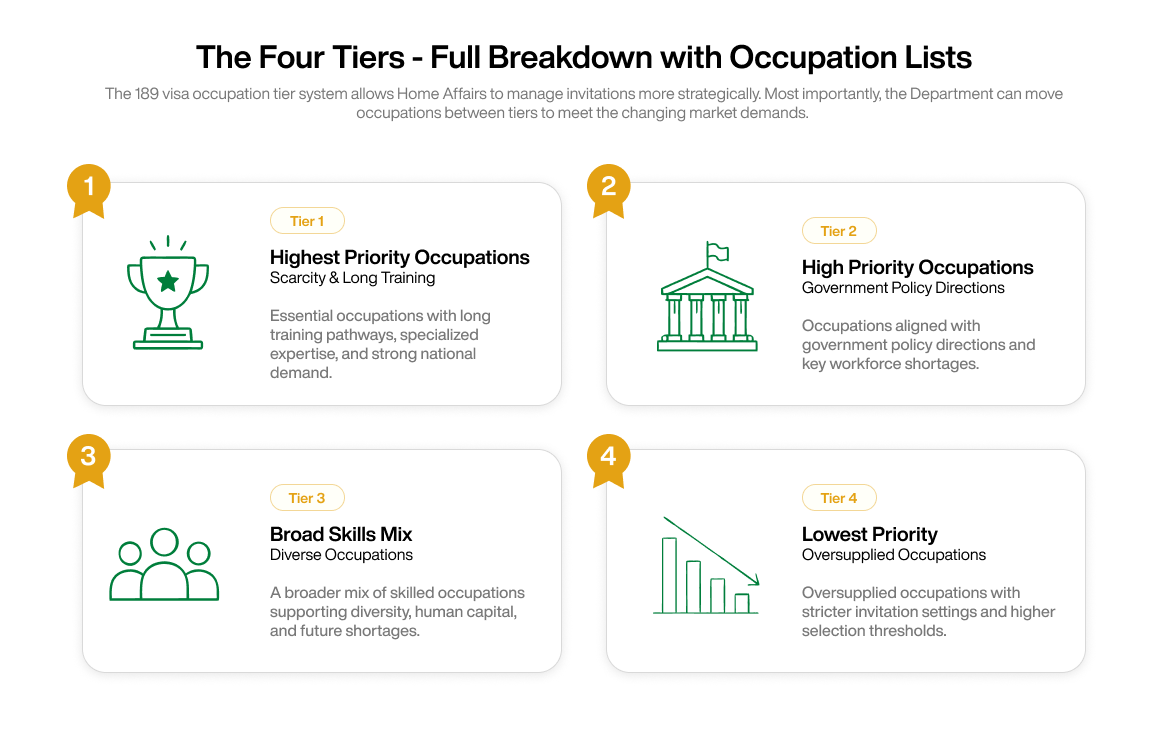
Tier 1 includes occupations considered essential to Australia's future workforce planning. These professions include long training pathways, specialised expertise, licensing, postgraduate training, and strong national demand. Because tier 1 occupations are highly important, they receive the highest weighting.
Tier 2 includes occupations that are connected to government priorities and listed under Ministerial Direction No. 105 (s499). This occupation tier is central to Australia's skilled migration program and enables the Department of Home Affairs to address workforce shortages in line with policy and economic demand.
This occupation tier includes a broader mix of general skilled occupations not listed in Tiers 1 and 2. The purpose of this tier is to:
Tier 4 generally includes oversupplied job roles with high volumes of EOIs. This oversupplied occupation tier faces highly restrictive invitation settings and requires:
The Department of Home Affairs has always applied lower occupation ceilings to these roles to reduce oversupply and prevent a particular occupation group from creating a bulk migration intake.
The FOI has also proposed reforming how SkillSelect operates to adopt a structured, coordinated approach to invitation management.
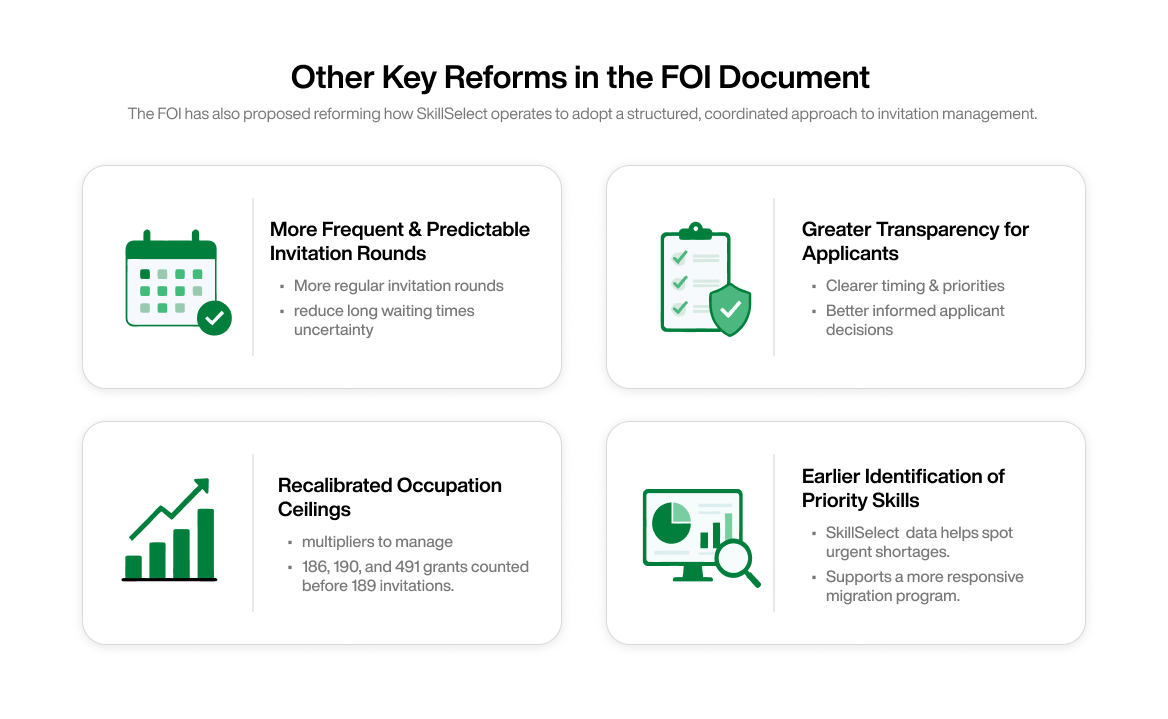
Recent invitation rounds have followed a more regular pattern, although the Department of Home Affairs continues to describe rounds as periodic. More frequent rounds reduce long waiting times and uncertainty about how many invitations each cycle will issue.
The proposed reform intends to improve communication with skilled migrants and maintain transparency in invitation timing, program priorities, and the selection process. This will help skilled migrants to submit EOIs and make informed decisions about regional provisional programs and multiple visa pathways.
The Department may recalculate occupancy ceilings using revised multipliers to manage the entire skilled program. So it will count subclass 186, 190, and 491 grants toward the ceiling before issuing 189 invitations.
The government plans to use SkillSelect EOI strategy data to identify and address urgent shortages. By shifting invitations, the Department develops a more coordinated, transparent, and responsive skilled migration program.
Your occupation's tier under the New 4-Tier Invitation System for 189 Visa now shapes your strategy as much as your points score. The reform changes how applicants should approach planning their skilled independent visa (subclass 189).
If You're in Tier 1 or Tier 2
If you're in Tier 1 or Tier 2, you may receive invitations even with lower points, especially in sectors with major skill shortages. While basic eligibility criteria still matter, your occupation ranking within these 189 visa occupation tiers may decide the final invitation outcome.
If You're in Tier 3
If you're in Tier 3, your focus should be on stronger point strategies, improving language test results, and gaining additional skilled employment. Skilled nominated programs, regional experience, and partner points may improve outcomes, and factoring your tier into your SkillSelect EOI strategy matters more here than it does higher up.
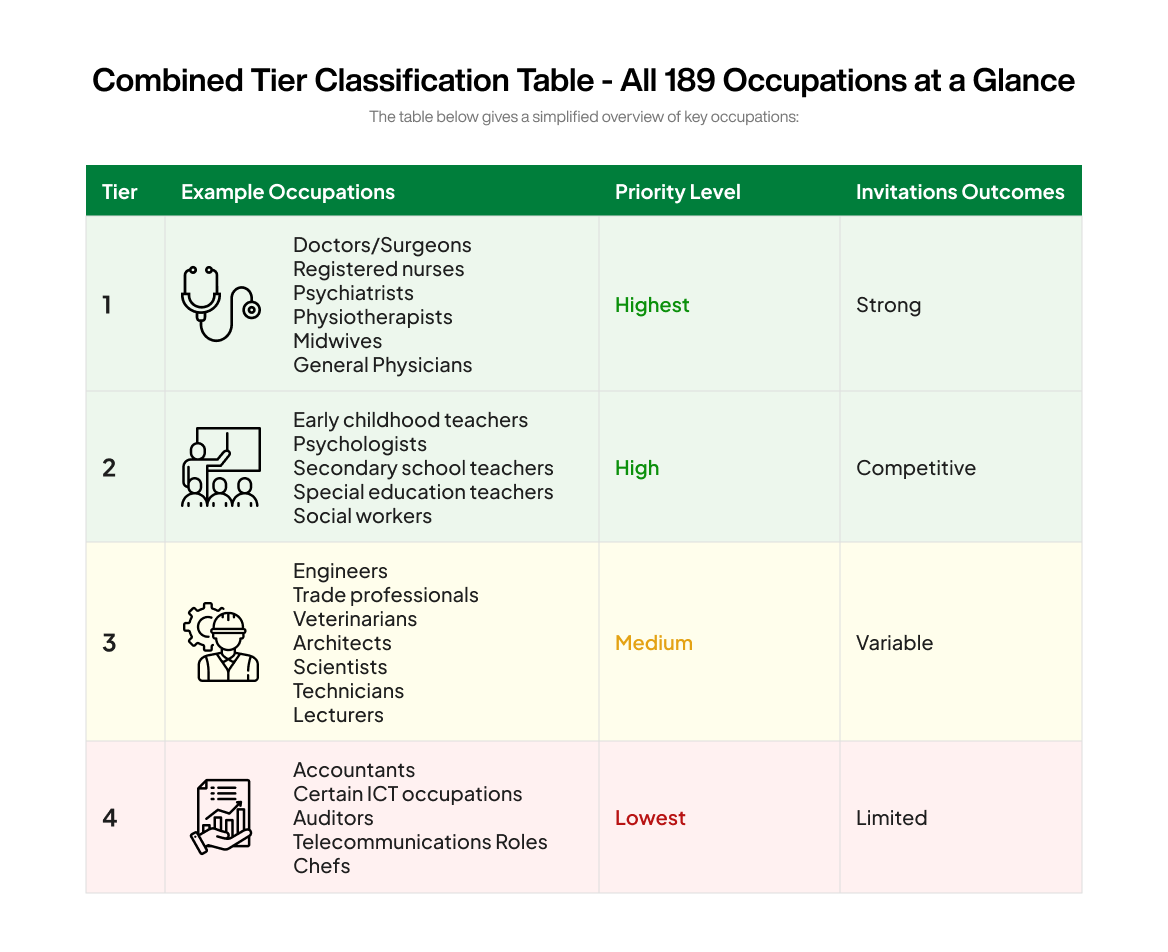
If You're in Tier 4 (Accountants, ICT, Chefs)
If you're in Tier 4, such as accountants, ICT professionals, and chefs, you'll be up against greater competition within a much smaller occupation ceiling 189 visa figure. You may have to explore regional visas, state nomination, employer-sponsored pathways, or regional provisional programs.
Occupation ceilings are calculated by applying a multiplier, typically between 2% and 4%, to Australian Bureau of Statistics employment stock data for that occupation, and this multiplier is exactly why your timeline moves faster or slower under the New 4-Tier Invitation System for 189 Visa.
According to the revised allocation process, the government may use this stock employment data to assess industry demand, then apply the multiplier to set an upper limit on that total stock figure. That multiplier comes from internal priority tiers, part of how 189 visa occupation tiers get assigned, which weigh training time and occupational shortages. Registered nurses and medical specialists receive the highest weightings, while roles like accountants, IT professionals, and HR managers sit in lower tiers, which is why the occupation ceiling 189 visa figure differs so much by occupation. Where your occupation sits here is worth factoring into your SkillSelect EOI strategy before you lodge.
You should take a structured approach to evaluating your eligibility under the same framework.
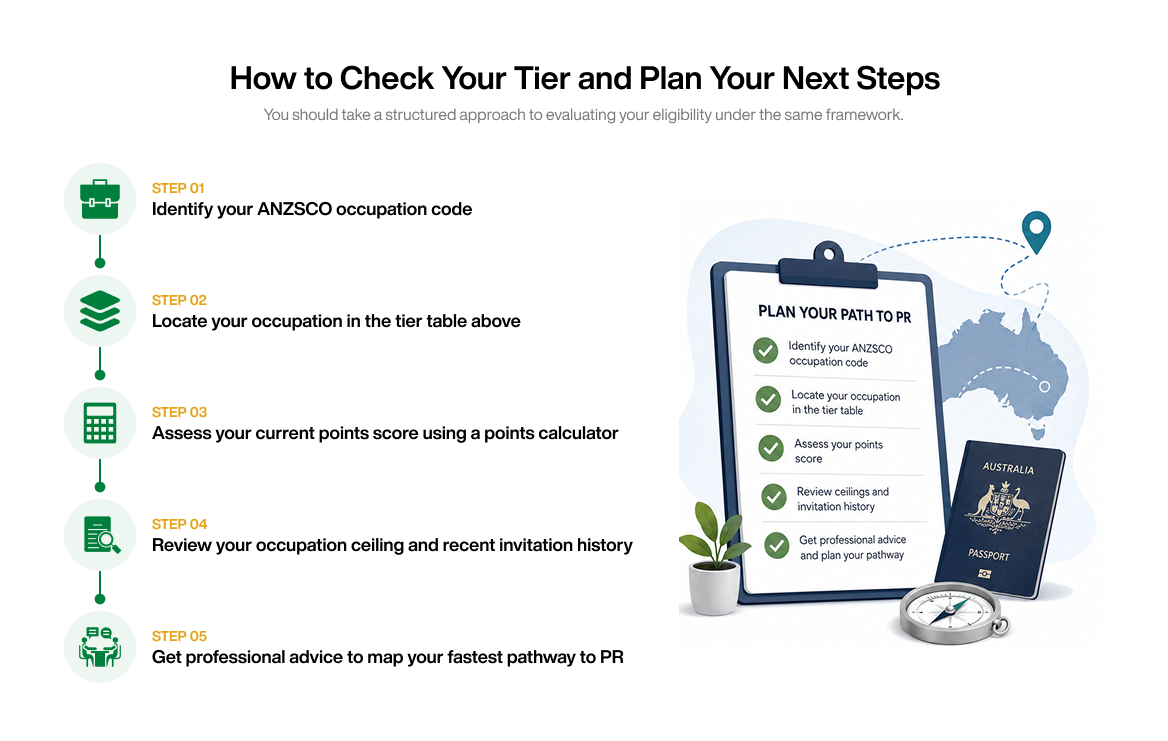
Check the ANZSCO occupation code in the Australian Bureau of Statistics ANZSCO Search to determine where your occupation sits within the proposed 189 visa tier.
Determine whether your occupation falls under the high-demand or lower-priority group.
Competitive invitation scores are generally high. Use the official Department of Home Affairs Points Calculator to calculate your points based on your age, English proficiency, and work experience.
Monitor historical placement invitations to determine the minimum points for an Invitation to Apply (ITA). You can track the latest minimum point scores and draw sizes on the SkillSelect Invitation Rounds Page.
A registered migration lawyer is qualified to help you evaluate the best visa pathway and ensure your qualifications map to your ANZSCO code. They can also guide you with state-nominated visas (Subclass 190/491) and prevent costly delays.
[câu chuyện thành công] [/câu chuyện thành công]
Yes, the Department can move occupations up or down tiers based on workforce demands and skill priorities.
No, the 4-tier system is an internal selection system for Subclass 189 (Skilled Independent) invitations only. 190 and 491 visas have their own specific criteria.
Since Tier 4 is highly competitive, invitations require scores in the 85-95+ range.
189 invitation rounds are held on a quarterly basis.
The four-tier framework emerged through internal planning documents and FOI disclosures to address national skill needs.
Review the Combined Subclass 189 Occupation Tier Classification published by authorised migration resources to find your 4-digit ANZSCO code in Tier 1 to 4.
While the minimum score needed for the 189 invitation is 65 points, the actual cut-off score is generally higher due to high competition. Check the historical pass marks on the Australian Government's SkillSelect Invitation Rounds page for a clearer overview.
Australian Migration Lawyers can help you keep up with changing ministerial direction policies, understand invitation trends, and overcome the challenges associated with the new tier system. You will get reliable guidance on EOI preparation, state nomination planning, and long-term strategic planning to navigate frequent changes in migration law.
Với 15 năm kinh nghiệm trong lĩnh vực luật pháp và hành chính công của Hoa Kỳ, tiếp theo là 5 năm hành nghề luật di trú Úc, Nick mang đến kiến thức chuyên môn pháp lý sâu rộng trên nhiều hệ thống pháp luật khác nhau cho công việc của mình với tư cách là một luật sư di trú Úc.
Nick có bằng Cử nhân Khoa học Chính trị của Đại học Bang Florida (năm 2000), bằng Tiến sĩ Luật của Trường Luật Đại học St. Thomas (năm 2004) và bằng Thạc sĩ Quản trị Công của Đại học Bang Florida (năm 2007). Ông là thành viên của Đoàn Luật sư Florida từ năm 2006 và Đoàn Luật sư Tòa Phúc thẩm Quận Columbia từ năm 2007, tạo dựng sự nghiệp luật sư quốc tế xuất sắc trước khi chuyển đến Melbourne vào năm 2021.
Sau khi hoàn thành chương trình học luật tại Úc ở Đại học La Trobe và Trường Cao đẳng Luật, ông đã được Tòa án Tối cao bang Victoria công nhận là luật sư Úc vào năm 2022. Sau đó, ông đã được cấp Số đăng ký hành nghề luật sư 5513285, nhờ đó ông hành nghề trong lĩnh vực luật di trú. Ông là thành viên của Viện Luật sư bang Victoria.
Nick cung cấp những lời khuyên chuyên môn về nhiều vấn đề liên quan đến di trú. Nhờ đã tự mình trải qua quy trình di trú, anh không chỉ sở hữu kiến thức chuyên môn mà còn thấu hiểu sâu sắc những trải nghiệm mà khách hàng phải đối mặt trong suốt quá trình này.
Nick phục vụ khách hàng trên toàn quốc, bao gồm tại Melbourne, Sydney, Brisbane, Perth và Adelaide, đồng thời cung cấp dịch vụ hỗ trợ toàn diện.
Ông đã đại diện cho khách hàng trong các vụ việc tại Tòa án Kiểm tra Hành chính (ART), mang kinh nghiệm tranh tụng tại tòa án này vào các vụ việc di trú phức tạp và có tranh chấp.
Ngoài công việc, Nick thích đọc sách, du lịch và khám phá văn hóa cà phê ở Melbourne.
THÔNG BÁO PHÁP LÝ: Các bài viết và bài đăng trên blog do Australian Migration Lawyers công bố chỉ mang tính chất cung cấp thông tin chung và không được coi là tư vấn về di trú hay tư vấn pháp lý. Việc đọc nội dung này không tạo ra mối quan hệ luật sư-khách hàng, và việc dựa vào nội dung này hoàn toàn do quý vị tự chịu rủi ro. Do luật di trú thường xuyên thay đổi, xin vui lòng tham khảo ý kiến của một luật sư Úc đã đăng ký để nhận được tư vấn chuyên nghiệp phù hợp với hoàn cảnh cụ thể của quý vị trước khi đưa ra bất kỳ quyết định nào liên quan đến di trú hoặc nộp đơn xin di trú.
Hãy cho chúng tôi biết về tình hình của bạn và chúng tôi sẽ sớm liên hệ lại với bạn.
Hãy cho chúng tôi biết về tình hình của bạn và chúng tôi sẽ sớm liên hệ lại với bạn.
Hãy cho chúng tôi biết một chút về tình huống của bạn và một trong những luật sư di trú của chúng tôi sẽ liên hệ lại với bạn sớm nhất có thể.
Our experienced migration lawyers are here to help —risk-free. Ask about our No Visa, No Fee options and we'll guide you through every step of your journey.

Chúng tôi đã tạo ra các hướng dẫn thị thực toàn diện phác thảo các đơn xin thị thực. Nhận của bạn ngay hôm nay.

%402x.svg)