Australia's largest independent migration law firm. Get a FREE Consultation T&C's apply
Need help? We are available 7 days a week.


Tell us about your situation, and our immigration lawyers will get back to you shortly.
Tell us about your situation, and our immigration lawyers will get back to you shortly.


2026 Telstra Best of Business Awards Nominee
.webp)

Winner of Most Trusted Australian Migration Law Firm 2023-2026

Ranked 1st for migration law in 2023, 2024 & 2025

Ranked in the top migration lawyers 2023, 2024, 2025 & 2026

Ranked the best migration law firm 2024 & 2025

.svg)
Decision-ready applications, prepared by lawyers.
No Visa, No Fee options available.*
Free initial consultation (T&Cs apply).
Key Takeaways
If you're a skilled worker looking to migrate to Australia and are open to living in a regional area, the Skilled Work Regional (Provisional) (subclass 491) visa could be a strong option for you. This visa provides a pathway to permanent residency for those who live, work and study in designated regional areas. While the 491 visa is available across various Australian states and territories, Victoria has its own specific eligibility requirements that depend on your current visa status, location, and employment situation. For other states, it is crucial that you look into the specific requirements outlined by the relevant authorities.
In this guide, we break down the key criteria for Victoria’s 491 nomination, outline the application process, explain your obligations after visa grant, and share practical tips to help you stay compliant and maximise your chances of success.
The subclass 491 visa is a temporary visa for skilled workers who want to live and work in a regional area of Australia.
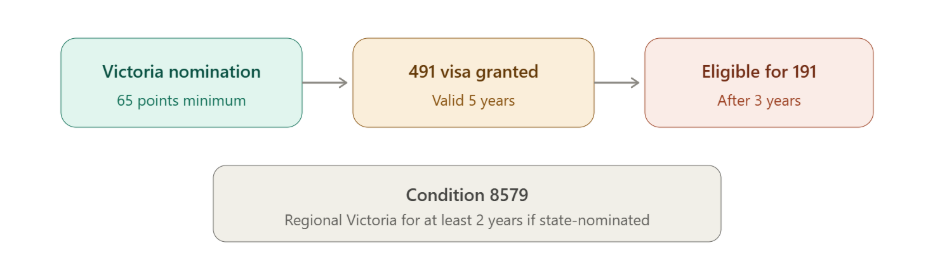
The 491 visa is valid for 5 years. After 3 years of holding this visa (and meeting the visa conditions), you can then apply for the subclass 191 Permanent Residence (Skilled Regional) visa, which is a permanent residence visa designed for temporary holders of regional visas like the 491.
To be eligible to submit an Expression of Interest for the 491, you generally need a minimum of 65 points on the points test, before any state nomination bonus is added. State nomination adds 15 points to your total score, which is a larger bonus than the 5 points added by 190 nomination, and is one of the main reasons some applicants pursue the 491 even where their base score alone would not be competitive for other skilled visa pathways. Your nominated occupation must also be on Victoria's current occupation list at the time of nomination.
[free_consultation]
If you are interested in getting more information about a visa, get in touch with Australian Migration Lawyers for a consultation.
[/free_consultation]
Victoria's skilled nomination program runs on an annual cycle and does not remain open continuously. Victoria's most recent completed program closed to new Registrations of Interest in late April 2026, and the program allocates places separately across the 190 and 491 visas each year. Before starting an ROI, check the current status of Victoria's program directly, since the steps above assume the program is open and accepting new interest.
A regional area for migration purposes is called a “designated regional area”, which covers most of Australia except for greater Melbourne, Sydney and Brisbane.
The regional definition is comprised of 2 categories:
This list of postcodes outlines all areas which are counted as “designated regional areas”.
This distinction surprises many applicants. Perth has a population of around 2 million people, yet it still counts as a designated regional area under this visa's framework, since the exclusion only applies to greater Melbourne, Sydney, and Brisbane specifically.
Each state or territory has its own set of requirements on regional areas. In this article, we will focus on Victoria’s requirements.
Whether you need to be living and/or working in regional Victoria to be eligible for nomination, depends on where you live and what visa you hold at the time of getting your ROI selected. The table below neatly sets out the requirements:
*Skilled employment refers to any role that is at skill levels 1, 2 or 3 in the relevant ANZSCO classification. It does not need to be related to or the same as your nominated occupation.
Our free skilled visa fee calculator can help you budget for the road ahead.
Among other requirements, the sponsor must be an eligible relative of yours or your spouse/partner who is:
[aml_difference][/aml_difference]
Once you are granted the subclass 491 visa, you (and all secondary visa holders) must only live, work and study in a designated regional area of Australia. If you are not living and working in a designated regional area at the time of visa grant, you are given a “reasonable period of time” to move to a designated regional area. You cannot move out of the designated regional area to metropolitan Melbourne, Sydney or Brisbane. This is a visa condition and failure to comply risks getting your visa cancelled.
This condition is known as Condition 8579. It is monitored throughout the life of the visa and again closely at the 191 permanent residence application stage, where you must provide evidence that you have complied throughout the required period.
You can move between different designated regional areas, even between states or territories, as long as the new area is still on the list of postcodes of designated regional areas.
However, if you were nominated by a state or territory, technically you are also expected to only live, work and study in a designated regional area of the nominating state or territory for a prescribed amount of time. If you were nominated by Victoria, you are expected to only live, work and study in a designated regional area of Victoria for at least 2 years, as this is what you would have committed to do when you apply for nomination from the Victorian government.
Here is how the 491 to 191 pathway fits together for a Victoria-nominated applicant.
The subclass 491 visa offers a promising route to permanent residency in Australia, especially for skilled workers willing to settle in regional areas. However, understanding the state-specific nomination criteria, especially in Victoria, is crucial to avoid delays or missed opportunities. Whether you're applying from overseas or already living in Australia, meeting the right employment and residency requirements — and staying compliant after your visa is granted — is key to a smooth migration journey.
[success_stories] [/success_stories]
If you're unsure about your eligibility or need help navigating the process, consulting a migration professional can make all the difference. At Australian Migration Lawyers, we're here to guide you every step of the way.
Our migration lawyers assist applicants across Melbourne and the broader region.
With 15 years of experience in United States law and public administration, followed by 5 years practising Australian migration law, Nick brings a depth of cross-jurisdictional legal expertise to his work as an Australian migration lawyer.
Nick holds a Bachelor of Arts in Political Science from Florida State University (2000), a Juris Doctorate from St. Thomas University School of Law (2004), and a Master of Public Administration from Florida State University (2007). He has been a member of the Florida Bar since 2006 and the District of Columbia Court of Appeals Bar since 2007, establishing a distinguished international legal career before relocating to Melbourne in 2021.
After completing his Australian legal studies at La Trobe University and The College of Law, he was admitted as an Australian lawyer by the Supreme Court of Victoria in 2022. He subsequently obtained Legal Practitioner Number 5513285, through which he practises in migration law. He is a member of the Law Institute of Victoria.
Nick offers expert guidance on a wide range of migration matters. Having personally navigated the migration process himself, he brings both professional expertise and genuine understanding of what clients experience throughout the process.
Nick serves clients nationally, including in Melbourne, Sydney, Brisbane, Perth, and Adelaide, providing comprehensive support.
He has represented clients in proceedings before the Administrative Review Tribunal (ART), bringing tribunal advocacy experience to complex and contested migration matters.
Outside his professional life, Nick enjoys reading, travel, and exploring Melbourne's coffee culture.
LEGAL DISCLAIMER: Articles and blog posts published by Australian Migration Lawyers provide general information only and do not constitute migration or legal advice. Reading this content does not create a lawyer-client relationship, and any reliance on it is strictly at your own risk. Because migration laws change frequently, please consult a registered Australian Lawyer for professional advice tailored to your specific circumstances before making any migration decisions or applications.
Tell us about your situation, and we will get back to you shortly.
Tell us about your situation, and we will get back to you shortly.
Tell us a little about your situation, and one of our migration lawyers will get back to you as soon as possible.
Our experienced migration lawyers are here to help —risk-free. Ask about our No Visa, No Fee options and we'll guide you through every step of your journey.
.webp)

We have created comprehensive visa guides that outline the ins and outs of visa applications. Get yours today.

%402x.svg)