Australia's largest independent migration law firm. Get a FREE Consultation T&C's apply
Need help? We are available 7 days a week.


Tell us about your situation, and our immigration lawyers will get back to you shortly.
Tell us about your situation, and our immigration lawyers will get back to you shortly.


2026 Telstra Best of Business Awards Nominee



Winner of Most Trusted Australian Migration Law Firm 2023-2026

Ranked 1st for migration law in 2023, 2024 & 2025

Ranked in the top migration lawyers 2023, 2024, 2025 & 2026

Ranked the best migration law firm 2024 & 2025

.svg)
Decision-ready applications, prepared by lawyers.
No Visa, No Fee options available.*
Free initial consultation (T&Cs apply).
Key Takeaways
The employer nomination scheme ENS visa is an employer sponsored visa that allows for permanent residence. The subclass 186 visa is split into three streams, being the Labour Agreement stream, Direct Entry stream and Temporary Residence Transition stream. All streams will allow the sponsored worker to remain in Australia indefinitely as a permanent resident, and provide a number of benefits to both the visa applicant and their nominating employer.
This article will outline the process of the employer nomination scheme, particularly the nomination application and the requirements for the visa application, and will outline the reasons why the employer nomination scheme visa is a useful tool for employers to facilitate the retention of skilled overseas workers where an australian employer is unable to find a suitable Australian worker for the position.
Since the age limit for the Temporary Residence Transition stream is a common point of confusion, it's worth noting upfront, there is no age limit for this stream. The under-45 age limit applies to the Direct Entry stream, subject to certain exemptions.
As mentioned above, the 186 visa can be a useful tool to ensure the retention of skilled overseas workers. Often, particularly under the Temporary Residence Transition stream, the overseas worker will already be employed by the nominating employer on a Skills in Demand visa (subclass 482). This stream allows 482 visa holders to apply for permanent residency with the support of their employer after two years working on the TSS. This is similar to sponsorship under the Labour Agreement stream, which will allow an employer sponsored visa holder in the 482 Labour Agreement stream to apply for permanent residence.
The Direct Entry stream is different from the other two streams as it can be applied for by a skilled worker even when they have never held a TSS (now Skills in Demand) visa. As the name suggests, it is a direct application to permanent residency, requiring a positive skills assessment from the relevant skills assessing authority, as well as a three years of work experience related to the nominated occupation. The criteria for all streams will be explained in further detail below.
[free_consultation]
If you are interested in getting more information about a visa, get in touch with Australian Migration Lawyers for a consultation.
[/free_consultation]
The retention of a skilled overseas worker has clear benefits to the employer, as they can retain their sponsored employee without worrying about further visa applications. The same goes for the visa applicant and their eligible family members, who can work and live in Australia with limited restrictions and eventually apply for Australian citizenship on meeting the eligibility requirements.
Subclass 186 visa holders will generally commit to working with their employer for a further two years after the date of the visa grant. While this is not a visa condition, often sponsored workers will comply to ensure that there are no potential issues relating to their eligibility for the visa, as they may be subject to cancellation if found to have misled the Australian Government in relation to their intentions. It is also often the case that employer sponsored workers will have developed a close relationship with their Australian employer, and will be grateful for the support in allowing them to apply for a permanent visa.
The basic eligibility criteria for the Employer Nomination Scheme ens visa can be summarised as follows.
Nominating employer criteria
Visa applicant criteria
Here is how the three 186 streams compare.
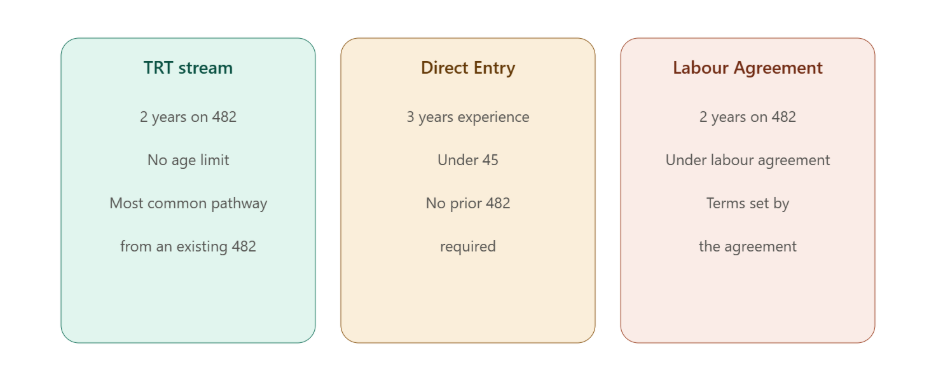
Sponsoring foreign workers under the ENS visa program can be broken down into two main steps, however for the labour agreement and temporary residence transition stream, there would have to have been a preceding employer sponsored visa. The worker must have been sponsored for at least two years on a relevant labour agreement, or on a TSS (now Skills in Demand) visa, before applying for the employer nomination scheme subclass 186. The direct entry stream does not have this requirement.
The first stage is for the employer to lodge a nomination application to sponsor the foreign worker and their eligible relatives, which outlines the conditions of employment as well as details of the nominated position. The nomination must be lodged before the visa application, and must demonstrate that there is a lack of skilled workers in the Australian labour market. Once lodged, the nomination can take around 4-6 weeks to process.
This nomination processing timeframe is distinct from, and considerably faster than, the overall visa application processing time for the 186, which has lengthened significantly and currently sits well beyond this figure depending on the stream. Employers and applicants should treat the nomination and visa stages as having very different timelines.
The second stage is the visa application for under the employer nomination scheme, which must be linked to the nomination. As one of many permanent residency visas, the stakes for this application can be quite high, so it is crucial to ensure that the application is robust and complete. This application will involve providing details of the primary applicant as well as their eligible family members. The primary applicant will also need to ensure that they have the prerequisite experience while holding a 482 visa with their nominating employer, or have a skills assessment if they are direct entry stream applicants.
[aml_difference][/aml_difference]
While there are fewer obligations on employers under the 186 visa when compared to other employer sponsored visas, it is still important for employers to understand their obligations. Employers must ensure that all workers are employed under the same terms and conditions as an equivalent Australian worker, and must ensure they pay the relevant market salary rate which must be above the minimum threshold of $79,423. An employer must also ensure that they do not engage in discriminatory recruitment practices when hiring overseas workers. Lastly, employers must keep the Department informed of any significant changes to the employment or sponsored worker’s circumstances.
Employers must also ensure that they do not hire workers with the promise of a sponsorship under the employer nomination scheme visa, or require additional commitments or work in exchange for a permanent visa. Like most employer sponsored visas, this visa is designed to address genuine ongoing worker shortages within a business, and should not be used primarily to entice workers to work for you or to remain employed by your business.
There are a number of common areas that an employer might struggle with when applying for this visa. The requirements and criteria for all visas can be difficult to address, as many are influenced heavily by Department policy and case law. The requirements relating to skills assessment applications, particularly relevant to the direct entry scheme, also vary greatly between the relevant assessing authority, which can result in extended delays.
To ensure a smooth application process, we recommend carefully ensuring that you would be eligible for the visa. This is best achieved by seeking advice from qualified professionals who have a clear understanding of employer sponsored visas.
At Australian Migration Lawyers, we have worked with a number of employers throughout a broad range of industries, and can provide clear tailored advice and assessments of your circumstances in order to ensure that you understand all the requirements and have considered all the options available to you.
[success_stories] [/success_stories]
As we have discussed in this article, there are a number of benefits and drawbacks of the 186 visa. Ultimately, this visa remains one of the most popular pathways to allow sponsored visa holders to gain permanent residence in order to continue working in their nominated position.
We encourage you to seek professional advice before making a decision, and at Australian Migration Lawyers, we have experience with a wide variety of skilled visas. We have assisted many skilled foreign workers in finding the best pathway, and would be happy to assist you in deciding how best to achieve your goals in Australia.
Joshua Coulson is a Senior Associate and seasoned Australian Migration Lawyer renowned for his experience in a diverse range of visa subclasses.
Focusing primarily in work and skilled visas, Joshua boasts extensive experience across various visa options and occupations. His portfolio includes crafting labour agreements such as Company Specific, DAMAs, and Industry Labour Agreements, allowing him to collaborate closely with employers navigating complex immigration scenarios.
Joshua graduated in law from the Australian Catholic University and obtained a Graduate Diploma in Legal Practice from the Leo Cussen Centre for Law. Following his admission to practice, Joshua quickly discovered his passion for immigration law. Driven by the distinctive challenges and rewards of this field, he has cultivated a profound understanding of immigration intricacies to guide clients clearly through their options and chart the optimal pathway towards their objectives. Joshua prides himself on offering personalized guidance to both employers and visa applicants, demystifying the intricate immigration process with tailored advice, detailed options, and a comprehensive overview of potential benefits.
With Joshua, expect transparent communication, proactive strategies, and steadfast advocacy tailored to your specific goals. He empathizes with the stress and uncertainty that often accompanies visa applications and takes every measure to keep clients reassured and well-informed about their application's progress.
Beyond his legal career, Joshua has dedicated time to volunteering with organizations offering legal aid to young offenders in police custody, demonstrating a commitment to supporting individuals through the legal system with empathy and compassion.
Joshua is eager to forge enduring relationships with employers and visa applicants alike, aiding employers in addressing workforce shortages while assisting skilled foreign workers in embarking on new journeys in Australia.
LEGAL DISCLAIMER: Articles and blog posts published by Australian Migration Lawyers provide general information only and do not constitute migration or legal advice. Reading this content does not create a lawyer-client relationship, and any reliance on it is strictly at your own risk. Because migration laws change frequently, please consult a registered Australian Lawyer for professional advice tailored to your specific circumstances before making any migration decisions or applications.
Tell us about your situation, and we will get back to you shortly.
Tell us about your situation, and we will get back to you shortly.
Quick, free tools to help you understand your options before you speak with a migration lawyer — estimate your visa costs or check your PR points.

Estimate Department of Home Affairs charges for employer-sponsored visas — Skills in Demand (subclass 482) nomination and visa, or Employer Nomination Scheme (subclass 186) — including the nomination fee, SAF levy and dependants.
Get Started
Estimate the Home Affairs visa application charge for subclass 189, 190 or 491 — including any partner or children applying with you.
Get Started
See where your score sits against the 65-point minimum for the Subclass 189, 190 and 491 visas, based on age, English ability, work experience and more.
Get StartedTell us a little about your situation, and one of our migration lawyers will get back to you as soon as possible.







-p-500.webp)

-p-2000.webp)

We have created comprehensive visa guides that outline the ins and outs of visa applications. Get yours today.

%402x.svg)