Australia's largest independent migration law firm. Get a FREE Consultation T&C's apply
Need help? We are available 7 days a week.


Tell us about your situation, and our immigration lawyers will get back to you shortly.
Tell us about your situation, and our immigration lawyers will get back to you shortly.


2026 Telstra Best of Business Awards Nominee


Winner of Most Trusted Australian Migration Law Firm 2023-2026

Ranked 1st for migration law in 2023, 2024 & 2025

Ranked in the top migration lawyers 2023, 2024, 2025 & 2026

Ranked the best migration law firm 2024 & 2025

.svg)
Decision-ready applications, prepared by lawyers.
No Visa, No Fee options available.*
Free initial consultation (T&Cs apply).
Key Takeaways
Schedule 3 of the Migration Regulations 1994 outlines additional visa requirements for visa applicants who hold only a bridging visa or other non-substantive visas or are unlawful non-citizens in Australia at the time of applying for a valid partner visa. A Schedule 3 waiver allows the Department of Home Affairs to overlook these criteria on a case-by-case basis, provided the visa applicant provides compelling reasons with evidence to support a new visa application. Here is a comprehensive guide to Schedule 3 and the waiver provisions.
Schedule 3 generally applies to onshore partner visa applicants who do not hold a substantive visa at the time of lodging a partner visa application. The visa applicant may then hold a criminal justice visa, a bridging visa, or a protection visa, or they may not have a legal permit to remain in the country. Schedule 3 sets further requirements and strict time limits that applicants must meet to receive their visa.
The core purpose of these Schedule 3 criteria is to assess the applicant's visa history and determine whether they attempted to regularise their visa status. These provisions discourage non-citizens from staying back in Australia unlawfully or gaining an unfair advantage over other visa applicants who have successfully complied with their visa application requirements.
Schedule 3 primarily affects individuals who lodged a partner visa application after their last substantive visa ceased and they became unlawful. These provisions also apply to non-substantive or bridging visa holders who were non-compliant with previous visa conditions or stayed back in Australia unlawfully for extended periods.
[free_consultation]
If you are interested in getting more information about a visa, get in touch with Australian Migration Lawyers for a consultation.
[/free_consultation]
Schedule 3 may apply where an applicant’s previous substantive visa has expired. The Department of Home Affairs will evaluate the visa status, efforts to regularise the situation, and whether unforeseen circumstances contributed to the delay.
Schedule 3 applies to criminal justice or enforcement visas where the Department will assess your visa history, court matters, and compliance with migration law.
An unlawful non-citizen without a valid Australian visa is subject to Schedule 3 in order to apply for a partner visa onshore and may be required to demonstrate compelling circumstances with supporting evidence for a Schedule 3 waiver.
If your current substantive visa has expired and you have not applied for a further visa, Schedule 3 will apply to your partner visa application. The Department of Home Affairs will evaluate the duration of your stay after your visa expired and the reasons you did not lodge a new visa application to decide whether there are compassionate grounds for a waiver.
[aml_difference][/aml_difference]
For most onshore partner visa applicants, criteria 3001, 3003, and 3004 apply together as a combined set, under clause 820.211(2)(d)(ii) of the Migration Regulations 1994 — the applicant must generally satisfy all three, unless the Minister is satisfied there are compelling reasons for not applying them. Criterion 3002 is a separate, alternative pathway that applies in specific circumstances, most commonly to applicants who held a special purpose visa on entry.
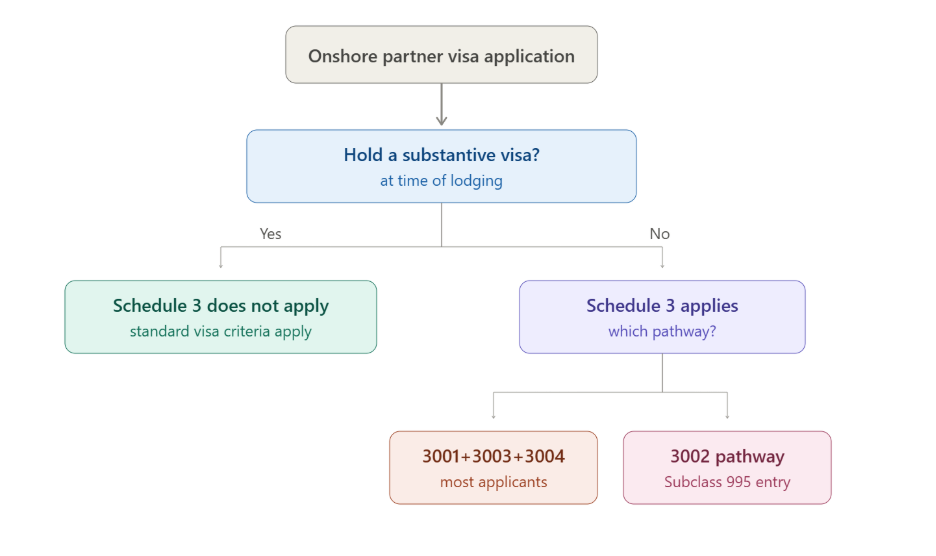
Criterion 3001 concerns timing, which requires you to apply for a new visa after your previous substantive visa expired. Applying beyond the timeframe (often 28 days) is a breach of 3001, and the Department may allow a waiver.
Criterion 3002 is an alternative pathway to 3001, 3003, and 3004, most relevant to applicants who entered Australia as a special purpose visa holder and met specified requirements at the time of entry. It is not a criterion that generally applies alongside 3001, 3003, and 3004 for most onshore partner visa applicants.
Criterion 3003 applies to an illegal entrant who entered Australia without a valid permit. In such cases, they must meet a few conditions.
Applicants who entered Australia unlawfully and do not hold a substantive visa must meet the following requirements under Criterion 3004.
A Schedule 3 waiver lets unlawful visa applicants or holders of non-substantive visas lodge a substantive visa application during their stay in the country, provided they fulfil all strict conditions.
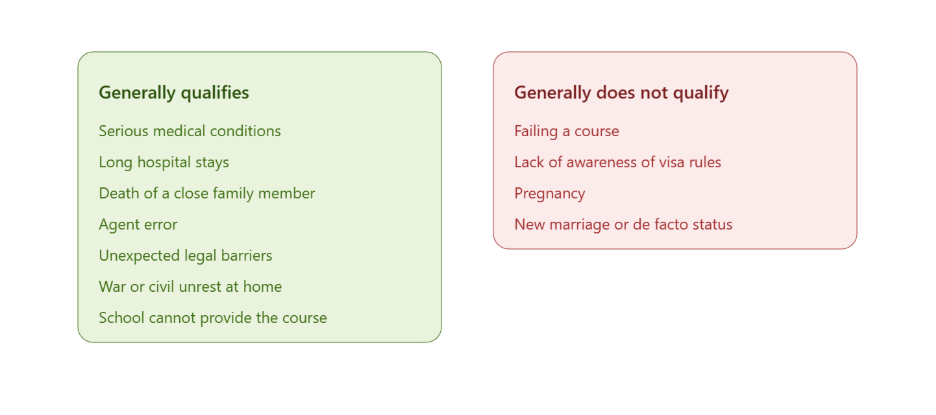
Compelling reasons are exceptional circumstances that may justify the grant of a waiver, including:
A long-term genuine relationship or the hardship of separation is not, on its own, generally treated as sufficiently compelling; particularly where the applicant remained unlawful for an extended period and made little or no effort to regularise their status. Compelling reasons are assessed on the applicant's full circumstances up to the time of the decision.
“Factors beyond my control” are circumstances that caused the applicant to remain in the country unlawfully without a permit through no fault of their own.
[success_stories] [/success_stories]
A Schedule 3 warning letter suggests that Schedule 3 criteria apply and gives you a deadline to provide submissions, reasons for your visa history, and evidence of your relationship and hardship. It is important to respond within the stipulated time with clear submissions and supporting evidence to ensure the Department is provided with all relevant information for assessment.
You can have the Schedule 3 requirements waived if you provide a statutory declaration detailing your circumstances and contrition, proof of honest compliance with the last visa requirements, and evidence of a stable relationship.
The Department may exercise its discretion to waive Schedule 3 where compelling circumstances exist and where the applicant can provide sound evidence in support of the waiver request.
If you do not get a successful outcome of your waiver request in Australia, the Department may refuse your partner visa as well. However, you may review your rights at the Administrative Review Tribunal (ART) within a strict timeframe stated in the refusal letter, generally around 21 days. Sometimes, applicants might have to leave Australia and consider applying for an offshore partner visa.
A Schedule 3 waiver is the Department’s discretion to approve your partner visa application request even if you do not meet the strict requirements of Schedule 3 due to compelling and compassionate reasons, backed by substantial evidence.
Yes, you can apply for an onshore partner visa (subclass 820/801) if you are unlawful, but you will have to meet the strict requirements listed under Schedule 3.
Compelling reasons for granting a Schedule 3 waiver include an Australian child, significant hardship, severe health conditions, factors beyond human control, and strong community ties.
Although relationship hardship may not be considered compelling enough on its own, it can contribute to a waiver if the separation causes significant emotional or practical challenges, especially if an Australian child or long-term ties are involved.
A declined waiver request could immediately lead to visa refusal or cancellation. However, you may appeal to the Administrative Review Tribunal (ART) within a strict timeframe stated in your decision letter.
No. Only applicants without a substantive visa, or unlawful non-citizens, or those who have been on certain non-substantive visas, need to meet Schedule 3 criteria. Applicants with valid visas or who have complied substantially with conditions are generally unaffected.
Review the warning letter and note the deadline. Prepare a detailed statement showing your visa history, hardship suffered, or any factor beyond your control, supported by documents and medical reports, if any. Consider seeking advice from a registered migration agent or an Australian lawyer regarding your response.
Schedule 3 waivers involve complex legal criteria and may lead to refusal if not addressed thoroughly. Australian Migration Lawyers can provide detailed advice on Schedule 3 requirements for partner visas. Contact our team to discuss your circumstances and obtain tailored legal guidance.
With 15 years of experience in United States law and public administration, followed by 5 years practising Australian migration law, Nick brings a depth of cross-jurisdictional legal expertise to his work as an Australian migration lawyer.
Nick holds a Bachelor of Arts in Political Science from Florida State University (2000), a Juris Doctorate from St. Thomas University School of Law (2004), and a Master of Public Administration from Florida State University (2007). He has been a member of the Florida Bar since 2006 and the District of Columbia Court of Appeals Bar since 2007, establishing a distinguished international legal career before relocating to Melbourne in 2021.
After completing his Australian legal studies at La Trobe University and The College of Law, he was admitted as an Australian lawyer by the Supreme Court of Victoria in 2022. He subsequently obtained Legal Practitioner Number 5513285, through which he practises in migration law. He is a member of the Law Institute of Victoria.
Nick offers expert guidance on a wide range of migration matters. Having personally navigated the migration process himself, he brings both professional expertise and genuine understanding of what clients experience throughout the process.
Nick serves clients nationally, including in Melbourne, Sydney, Brisbane, Perth, and Adelaide, providing comprehensive support.
He has represented clients in proceedings before the Administrative Review Tribunal (ART), bringing tribunal advocacy experience to complex and contested migration matters.
Outside his professional life, Nick enjoys reading, travel, and exploring Melbourne's coffee culture.
LEGAL DISCLAIMER: Articles and blog posts published by Australian Migration Lawyers provide general information only and do not constitute migration or legal advice. Reading this content does not create a lawyer-client relationship, and any reliance on it is strictly at your own risk. Because migration laws change frequently, please consult a registered Australian Lawyer for professional advice tailored to your specific circumstances before making any migration decisions or applications.
Tell us about your situation, and we will get back to you shortly.
Tell us about your situation, and we will get back to you shortly.
Tell us a little about your situation, and one of our migration lawyers will get back to you as soon as possible.
Our experienced migration lawyers are here to help —risk-free. Ask about our No Visa, No Fee options and we'll guide you through every step of your journey.


We have created comprehensive visa guides that outline the ins and outs of visa applications. Get yours today.

%402x.svg)