Australia's largest independent migration law firm. Get a FREE Consultation T&C's apply
¿Necesita ayuda? Estamos a su disposición 7 días a la semana.


Cuéntenos su situación y nuestros abogados de inmigración se pondrán en contacto con usted en breve.
Cuéntenos su situación y nuestros abogados de inmigración se pondrán en contacto con usted en breve.


Nominado a los premios «Telstra Best of Business Awards» de 2026


Ganador del premio al bufete de abogados especializado en migración más fiable de Australia 2023-2026

Primer puesto en Derecho de migración en 2023, 2024 y 2025

Clasificado entre los mejores abogados especializados en inmigración de 2023, 2024, 2025 y 2026

Mejor bufete de migración 2024 y 2025

.svg)
Solicitudes listas para su resolución, elaboradas por abogados.
No Visa, No Fee options available.*
Consulta inicial gratuita (se aplican los términos y condiciones).
Puntos clave
Victoria has announced two significant developments ahead of its 2026-27 skilled visa nomination program: the introduction of state-level fees for service and the publication of detailed selection information through the Victorian Points Test. The 2025-26 program is now closed to new Registrations of Interest, and applicants who wish to be considered under the new program year must act when it opens. This article explains what has changed, how selection works, and what these updates mean for skilled professionals considering Victoria as their nomination pathway.
The Victorian Government will charge fees for service when skilled visa applicants submit Registrations of Interest and nomination applications through the Live in Melbourne portal. These changes apply to the Skilled Nominated visa (Subclass 190) and the Skilled Work Regional (Provisional) visa (Subclass 491).
[consulta_gratuita]
Si está interesado en obtener más información sobre un visado, póngase en contacto con Australian Migration Lawyers para una consulta.
[/consulta_gratis]
The 2026-27 fees are as follows:
Goods and Services Tax of 10% applies where the applicant is physically in Australia at the time of payment. The system calculates and applies this automatically when the application form is completed.
Two points are worth noting for those managing their budget across both state and federal costs. The Registration of Interest fee is charged once per program year: if an applicant withdraws and lodges a new Registration of Interest within the same year, no additional fee applies. The nomination application fee is only payable if the applicant receives an invitation to apply for nomination and then proceeds to submit that application. An applicant who submits a Registration of Interest but is not invited incurs only the Registration of Interest fee.
It is also important to distinguish these state-level fees from the federal visa application charge. From 1 July 2026, the Department of Home Affairs’ base application charge for the main applicant is $6,140 for both the Subclass 190 and the Subclass 491, with additional charges for each family member included in the application. The Victorian fees are separate fees for service payable to the state government, not to the Department of Home Affairs.
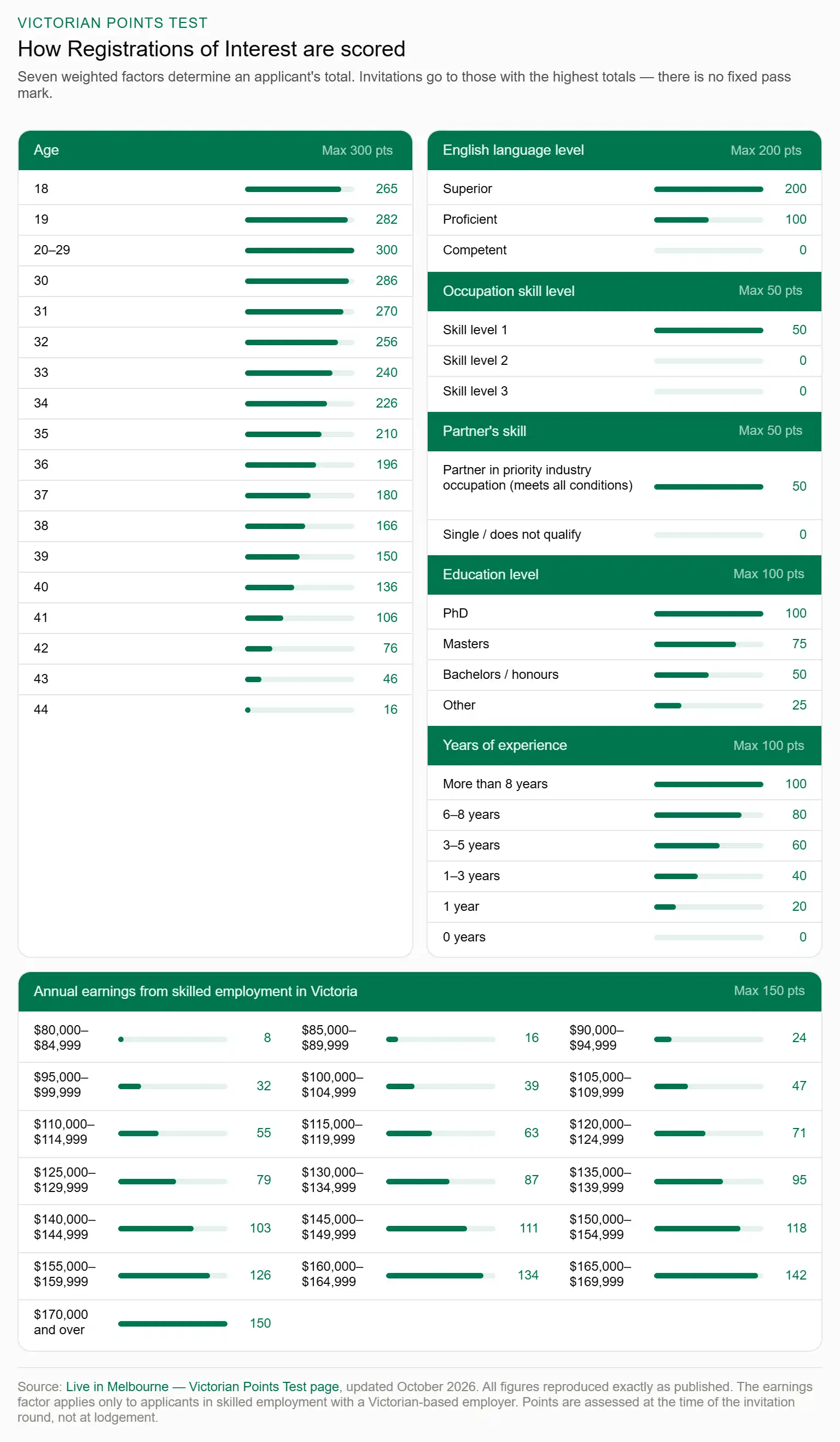
Victoria uses the Victorian Points Test (VPT) to rank all Registrations of Interest in the pool. Seven weighted factors contribute to an applicant’s total: age, English language level, years of experience in the nominated occupation, educational qualification, occupation skill level, partner’s skill (where applicable), and annual earnings from current skilled employment in Victoria (where applicable).
The test places significant weight on age, with applicants aged 20 to 29 attracting the maximum 300 points and points declining with age from 30 onwards. English language proficiency also carries substantial weight, with a Superior rating attracting 200 points compared to zero for Competent. Work experience, education level, and occupation skill level contribute further points, and applicants currently in skilled employment in Victoria earning $80,000 or more may attract additional points based on their annual earnings.
Crucially, the Victorian Points Test does not operate on a fixed pass mark. Unlike the Australian Government’s points test via SkillSelect, which requires a minimum of 65 points, the VPT ranks applicants against one another. Invitations are issued to those with the highest totals in each round, meaning competitiveness depends on the composition of the pool at the time an invitation round is conducted. The Victorian Government cannot advise individual applicants on their likelihood of receiving an invitation or how their score compares with others in the pool.
To estimate your Victorian Points Test total before lodging a Registration of Interest, use the Victorian Points Test Calculator on our website.
[aml_difference][/aml_difference]
In addition to general competitive selection, Victoria prioritises certain occupations to address critical skills needs. Applicants in these occupations are also ranked within their priority industry or subgroup, giving them a second route to invitation alongside the general competitive pool.
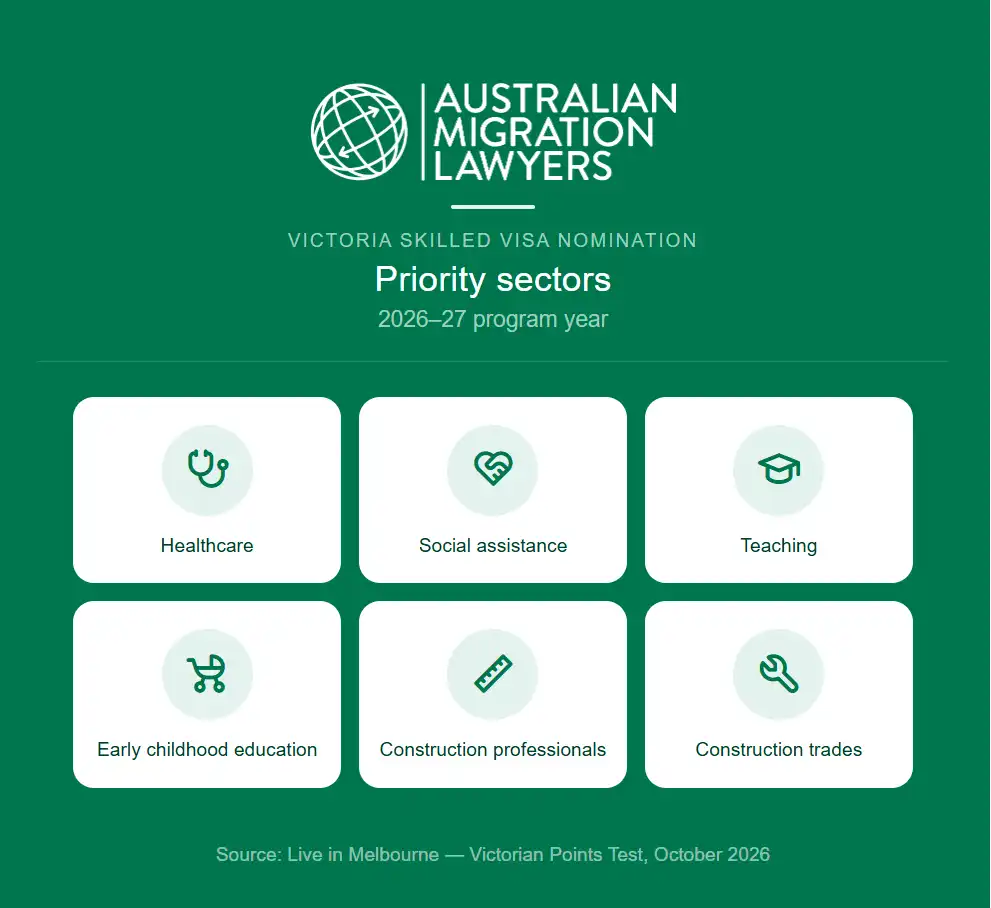
The 2026-27 priority industries are healthcare, social assistance, education, and construction. Within these broad categories, specific subgroups and additional eligibility criteria apply.
Healthcare covers a wide range of occupations, including allied health professionals such as occupational therapists, physiotherapists, speech pathologists, and audiologists; registered nurses across a range of clinical specialisations; medical imaging professionals; and specialist physicians and surgeons across disciplines including cardiology, oncology, psychiatry, and neurosurgery. Midwives and dental technicians also appear on the healthcare list.
Social assistance encompasses clinical psychologists, educational psychologists, organisational psychologists, social workers, and welfare workers.
Education is divided into two subgroups: teachers (covering middle school, secondary school, and special needs teachers) and early childhood education, covering early childhood teachers. Within the early childhood subgroup, Registrations of Interest held by applicants with at least one year of relevant work experience and Proficient or Superior English will be prioritised for invitation.
Construction is similarly divided, with a professionals subgroup covering roles such as construction project managers, surveyors, geotechnical engineers, geophysicists, hydrogeologists, and other spatial scientists, and a trades subgroup covering a broad range of trades including electricians, plumbers, carpenters, bricklayers, and air-conditioning and refrigeration mechanics, among others.
Victoria has indicated that further program details will be published when the 2026-27 program opens, so priorities may be refined. Applicants are encouraged to review the full Victorian Points Test page on the Live in Melbourne website to confirm whether their occupation and subgroup appear in the current priority list before lodging a Registration of Interest. If you are unsure whether your occupation qualifies or how your profile is likely to be assessed, contact Australian Migration Lawyers for guidance specific to your circumstances.
A point of significant practical importance: Registrations of Interest submitted in a previous program year do not automatically carry over into 2026-27. Any applicant who submitted a Registration of Interest under an earlier program and wishes to be considered for Victorian nomination in 2026-27 must log in to the Live in Melbourne portal and submit a new Registration of Interest when the program opens. The Victorian Government has not yet confirmed the opening date for the 2026-27 program; updates will be published on the Live in Melbourne website when available.
The introduction of state-level fees and the publication of selection criteria represent meaningful changes for anyone pursuing Victorian nomination. Applicants need to understand both the financial costs and the competitive dynamics before deciding whether to pursue the Victorian pathway.
The state nomination fees are modest relative to the overall cost of a skilled visa application, but they are now a cost that must be planned for. More significantly, the publication of the Victorian Points Test weightings and priority industries gives applicants a clearer picture of how competitive their profile is likely to be.
Skilled migration is a complex, competitive process and the circumstances that affect an individual’s eligibility, points score, and prospects of nomination require careful assessment. Australian Migration Lawyers is available seven days a week to discuss your circumstances, review your options across state and territory nomination programs, and advise on the most appropriate visa pathway.
[historias_de_éxito] [/historias_de_éxito]
Our migration lawyers work with skilled applicants at every stage of the process, from confirming eligibility and preparing a strong Expression of Interest through to managing the nomination application and visa lodgement. We understand the nuances of state-specific programs and can advise on how recent changes to Victoria’s program may affect your position relative to other applicants.
If you are considering a Subclass 190 or Subclass 491 visa and want to understand how the 2026-27 Victorian program applies to your circumstances, contact our team today.
Con 15 años de experiencia en derecho y administración pública de Estados Unidos, a los que siguen 5 años de ejercicio del derecho de inmigración australiano, Nick aporta a su trabajo como abogado especializado en inmigración australiana una profunda experiencia jurídica en distintos ordenamientos jurídicos.
Nick es licenciado en Ciencias Políticas por la Universidad Estatal de Florida (2000), doctor en Derecho por la Facultad de Derecho de la Universidad de St. Thomas (2004) y máster en Administración Pública por la Universidad Estatal de Florida (2007). Es miembro del Colegio de Abogados de Florida desde 2006 y del Colegio de Abogados del Tribunal de Apelaciones del Distrito de Columbia desde 2007, y ha desarrollado una distinguida carrera jurídica internacional antes de trasladarse a Melbourne en 2021.
Tras completar sus estudios de Derecho en Australia en la Universidad de La Trobe y en The College of Law, fue admitido como abogado australiano por el Tribunal Supremo de Victoria en 2022. Posteriormente, obtuvo el número de colegiado 5513285, con el que ejerce en el ámbito del Derecho de inmigración. Es miembro del Instituto de Derecho de Victoria.
Nick ofrece asesoramiento especializado sobre una amplia variedad de cuestiones relacionadas con la inmigración. Al haber pasado él mismo por el proceso de inmigración, aporta tanto su experiencia profesional como una comprensión genuina de lo que viven los clientes a lo largo de todo el proceso.
Nick atiende a clientes de todo el país, entre ellos de Melbourne, Sídney, Brisbane, Perth y Adelaida, a los que ofrece un apoyo integral.
Ha representado a clientes en procedimientos ante el Tribunal de Revisión Administrativa (ART), aportando su experiencia en la defensa ante este tribunal a asuntos migratorios complejos y controvertidos.
Fuera de su vida profesional, a Nick le gusta leer, viajar y descubrir la cultura del café de Melbourne.
AVISO LEGAL: Los artículos y entradas de blog publicados por Australian Migration Lawyers ofrecen únicamente información general y no constituyen asesoramiento jurídico ni en materia de inmigración. La lectura de este contenido no da lugar a una relación abogado-cliente, y cualquier decisión que se tome basándose en él es estrictamente bajo su propia responsabilidad. Dado que la legislación en materia de inmigración cambia con frecuencia, le recomendamos que consulte a un abogado australiano colegiado para obtener asesoramiento profesional adaptado a sus circunstancias específicas antes de tomar cualquier decisión o presentar cualquier solicitud relacionada con la inmigración.
Cuéntenos su situación y nos pondremos en contacto con usted en breve.
Cuéntenos su situación y nos pondremos en contacto con usted en breve.
Quick, free tools to help you understand your options before you speak with a migration lawyer — estimate your visa costs or check your PR points.

Estimate Department of Home Affairs charges for employer-sponsored visas — Skills in Demand (subclass 482) nomination and visa, or Employer Nomination Scheme (subclass 186) — including the nomination fee, SAF levy and dependants.
Get Started
Estimate the Home Affairs visa application charge for subclass 189, 190 or 491 — including any partner or children applying with you.
Get Started
See where your score sits against the 65-point minimum for the Subclass 189, 190 and 491 visas, based on age, English ability, work experience and more.
Get StartedCuéntenos un poco su situación y uno de nuestros abogados especializados en migración se pondrá en contacto con usted lo antes posible.

Our experienced migration lawyers are here to help —risk-free. Ask about our No Visa, No Fee options and we'll guide you through every step of your journey.


Hemos creado unas completas guías de visados que describen los pormenores de las solicitudes de visado. Consiga la suya hoy mismo.

%402x.svg)