Australia's largest independent migration law firm. Get a FREE Consultation T&C's apply
Need help? We are available 7 days a week.


Tell us about your situation, and our immigration lawyers will get back to you shortly.
Tell us about your situation, and our immigration lawyers will get back to you shortly.


2026 Telstra Best of Business Awards Nominee



Winner of Most Trusted Australian Migration Law Firm 2023-2026

Ranked 1st for migration law in 2023, 2024 & 2025

Ranked in the top migration lawyers 2023, 2024, 2025 & 2026

Ranked the best migration law firm 2024 & 2025

.svg)
Decision-ready applications, prepared by lawyers.
No Visa, No Fee options available.*
Free initial consultation (T&Cs apply).
Key Takeaways
A visa refusal occurs when the Department of Home Affairs denies an individual's application to enter or stay in a country. This could be due to various reasons, ranging from incomplete documentation to concerns about an applicant's eligibility.
In plain terms, a refusal simply means the Department decided you did not meet the criteria for the specific visa you applied for; it is a decision on that application, not necessarily a permanent judgment about your character or your ability to ever be granted an Australian visa. That said, depending on the type of visa and the grounds for refusal, a refusal can have real and sometimes serious consequences for what you can apply for next, which this article explains.
The impact a visa refusal has on your future visa applications depends on what kind of visa you initially applied for, the grounds on which your visa was refused and other individual circumstances. Generally speaking, your visa refusal will be recorded in your immigration history, thus any future application you may make will be subject to increased scrutiny. Furthermore, the Department of Home Affairs will closely examine your character and integrity, making it crucial to address any concerns that led to the initial refusal.
However, there are several specific factors which determine what options are available to you after a visa refusal.
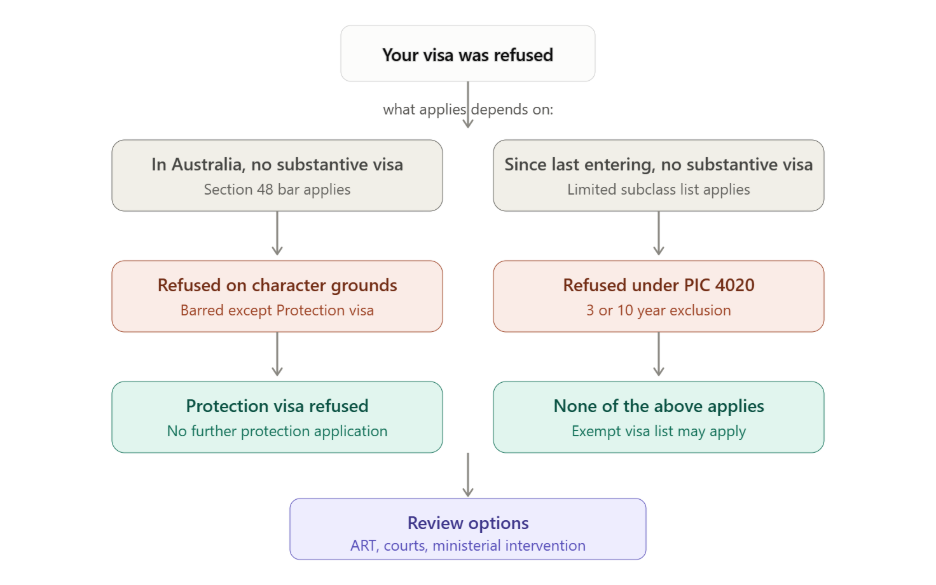
This maps the main scenarios covered in the article; which rule applies depends on your immigration status, the grounds for refusal, and whether you're dealing with a protection visa specifically.
If you do not hold a substantive visa and were refused a visa, other than a Bridging, visa since last entering Australia, your subsequent visa application will be limited to the following subclasses:
Please note that although you can submit a visa application under these conditions, your visa will not be approved unless you meet the specific criteria outlined in the Migration Regulations.
[free_consultation]
If you are interested in getting more information about a visa, get in touch with Australian Migration Lawyers for a consultation.
[/free_consultation]
If your visa application was refused whilst you are in Australia and you do not have a substantive visa, s 48 of the Migration Act 1958 (Cth) will apply. The ‘section 48’ bar prevents you from applying for most other visas while you are in Australia, thus you will need to leave Australia before you can reapply for a visa.
In practice, this means the section 48 bar is one of the most common reasons someone finds themselves unable to simply "apply again" for a different visa after a refusal while still in Australia. It doesn't mean you can never apply again; it means most applications need to be made from outside Australia, unless your situation falls within the specific exempt list below.
However, there are some visas which are exempt from the section 48 bar, meaning that you can still apply for the following visas:
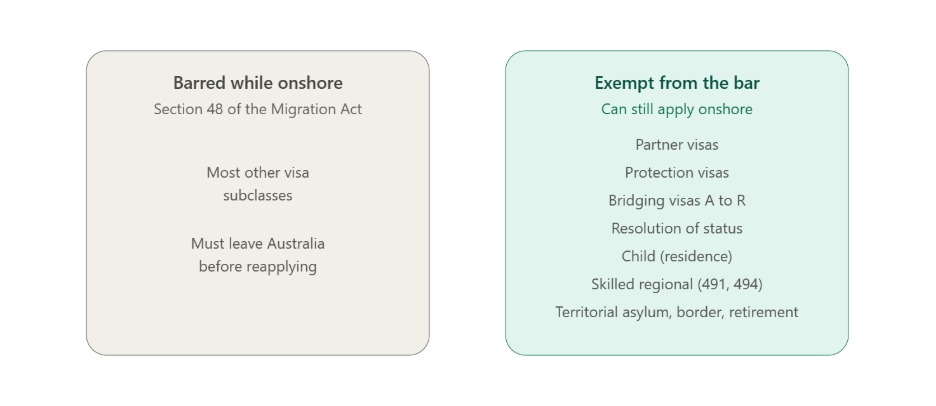
The exempt list is longer than most people expect partner, protection, bridging, and several skilled regional pathways all remain available onshore even under a section 48 bar.
If you previously applied for a protection visa (subclass 866) and it was refused:
If, since you last entered Australia, you have applied for a protection visa and have been refused, you cannot make a further application for a protection visa while in Australia. An exception to this is where the Minister decides it is in the public interest to allow you to lodge a further application.
This restriction applies specifically to making another protection visa application — it does not necessarily prevent you from being considered for a different visa category if one is otherwise available to you, such as under the exempt list above (for example, a Partner visa, if you genuinely meet the criteria). If you were refused a protection visa while onshore, it's worth discussing your full range of options with a migration lawyer rather than assuming a protection visa refusal closes off every pathway.
[aml_difference][/aml_difference]
If you visa was refused on character grounds:
The consequences of a visa refusal based on character grounds are the most significant, if you have had a visa refused on character grounds since you last arrived in Australia, you will be prevented from making any further visa applications, except for a Protection visa (subclass 866).
This is a deliberately severe consequence, reflecting how seriously character-related refusals are treated under Australian migration law. If you believe a character-based refusal was made in error, or if there are compelling circumstances in your case, options such as merits review at the Administrative Review Tribunal or, in limited cases, judicial review or ministerial intervention may still be available; see the "Alternatives" section below. This is an area where early, specific legal advice makes a real difference.
If your visa was refused due to a failure to satisfy PIC 4020:
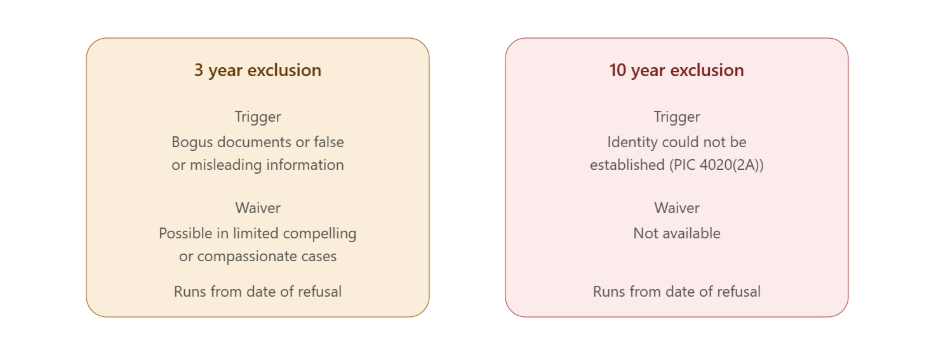
If you have had a visa refused through the operation of Public Interest Criteria (PIC) 4020, you may be prevented from being granted a further visa to Australia. PIC 4020 is an integrity measure aimed at preventing fraud in the visa migration program. If you supplied bogus documents or information which is false or misleading in relation to your visa application, PIC 4020 may apply. In this case, you may be subject to a three-year exclusion period during which you will not be granted a visa that includes PIC 4020 as a criterion. Furthermore, if the Minister has refused your application under PIC 4020(2A) (i.e. the Minister is not satisfied of your identity), you could face a 10 year ban.
A few important details are worth knowing if PIC 4020 applies to you. The exclusion period generally runs from the date of the refusal decision itself, not from the date you lodged your original application or the date you eventually lodge a new one; so, it's important to work out your exact exclusion end date before attempting to reapply. The 3-year exclusion may, in limited circumstances, be capable of a discretionary waiver where there are compelling circumstances affecting Australia's interests, or compassionate circumstances affecting an Australian citizen, permanent resident, or eligible New Zealand citizen; though waivers are granted sparingly. The 10-year identity-related exclusion generally cannot be waived. It's also worth noting that a PIC 4020 finding can affect not just you, but other members of your family unit included in the same application.
In addition to considering the options for applying for another visa, there are alternative avenues through which you may seek to have your refusal or cancellation decision reconsidered. This can be pursued through various channels:
Whichever path applies to your situation, two things generally help regardless of the mechanism: directly and specifically addressing the reasons given for the original refusal, rather than simply resubmitting similar information, and being upfront about your full immigration history in any new application, since undisclosed previous refusals can themselves raise character or integrity concerns in a later application.
Given the potential serious consequences of visa refusal, it is recommended that you engage the support of a Migration lawyer, who will be able to assist you in identifying where your application could improve and addressing any concerns that might be had by immigration authorities.
[success_stories] [/success_stories]
If a partner (spouse) visa is refused, the consequences depend heavily on your circumstances ; particularly whether you hold a substantive visa, whether you're in or outside Australia, and the actual grounds for refusal. Partner visas are among the categories exempt from the section 48 bar in many cases, which means a further partner visa application may still be possible from within Australia in some situations. However, if the refusal involved character concerns or PIC 4020, more significant restrictions can apply. Because outcomes vary so much case by case, this is a situation where speaking with a migration lawyer promptly makes a real difference.
Not directly. A refusal of a visa to a different country, such as the United States, does not automatically affect an Australian visa application, since it isn't an Australian immigration decision. However, Australian visa applications generally ask about any visa refusals from any country and providing complete and accurate information about your immigration history including refusals from other countries is required. Failing to disclose a genuinely relevant prior refusal could itself raise integrity concerns in your Australian application, even though the original US refusal has no direct legal effect on Australian law.
The Business Innovation and Investment (subclass 188) visa program is subject to the same general refusal consequences described in this article including the section 48 bar, PIC 4020, and character grounds provisions since these are general Migration Act and Regulations provisions that apply across visa categories, not rules specific to any one visa. It's worth noting that the subclass 188 program has been closed to new applications since 2025, so anyone affected by a subclass 188 refusal should discuss current alternative pathways with a migration lawyer.
This wording generally indicates that the Department has determined it is unable to process your application further, often because a legal bar (such as section 48) applies, required information or documents weren't provided within the requested timeframe, or a specific eligibility requirement clearly isn't met. It is not the same as a substantive refusal on the merits of your case, but it has a similar practical effect, in that your application won't proceed. If you've received this message, it's important to read it carefully as it should explain the specific reason. Seek advice promptly, since there may be limited time to respond or to consider your next steps.
Contact Australian Migration Lawyers if you have received a visa refusal and need to understand your options. We can help you assess your circumstances and identify the best path forward.
With 15 years of experience in United States law and public administration, followed by 5 years practising Australian migration law, Nick brings a depth of cross-jurisdictional legal expertise to his work as an Australian migration lawyer.
Nick holds a Bachelor of Arts in Political Science from Florida State University (2000), a Juris Doctorate from St. Thomas University School of Law (2004), and a Master of Public Administration from Florida State University (2007). He has been a member of the Florida Bar since 2006 and the District of Columbia Court of Appeals Bar since 2007, establishing a distinguished international legal career before relocating to Melbourne in 2021.
After completing his Australian legal studies at La Trobe University and The College of Law, he was admitted as an Australian lawyer by the Supreme Court of Victoria in 2022. He subsequently obtained Legal Practitioner Number 5513285, through which he practises in migration law. He is a member of the Law Institute of Victoria.
Nick offers expert guidance on a wide range of migration matters. Having personally navigated the migration process himself, he brings both professional expertise and genuine understanding of what clients experience throughout the process.
Nick serves clients nationally, including in Melbourne, Sydney, Brisbane, Perth, and Adelaide, providing comprehensive support.
He has represented clients in proceedings before the Administrative Review Tribunal (ART), bringing tribunal advocacy experience to complex and contested migration matters.
Outside his professional life, Nick enjoys reading, travel, and exploring Melbourne's coffee culture.
LEGAL DISCLAIMER: Articles and blog posts published by Australian Migration Lawyers provide general information only and do not constitute migration or legal advice. Reading this content does not create a lawyer-client relationship, and any reliance on it is strictly at your own risk. Because migration laws change frequently, please consult a registered Australian Lawyer for professional advice tailored to your specific circumstances before making any migration decisions or applications.
Tell us about your situation, and we will get back to you shortly.
Tell us about your situation, and we will get back to you shortly.
Quick, free tools to help you understand your options before you speak with a migration lawyer — estimate your visa costs or check your PR points.

Estimate Department of Home Affairs charges for employer-sponsored visas — Skills in Demand (subclass 482) nomination and visa, or Employer Nomination Scheme (subclass 186) — including the nomination fee, SAF levy and dependants.
Get Started
Estimate the Home Affairs visa application charge for subclass 189, 190 or 491 — including any partner or children applying with you.
Get Started
See where your score sits against the 65-point minimum for the Subclass 189, 190 and 491 visas, based on age, English ability, work experience and more.
Get StartedTell us a little about your situation, and one of our migration lawyers will get back to you as soon as possible.







-p-500.webp)

-p-2000.webp)

We have created comprehensive visa guides that outline the ins and outs of visa applications. Get yours today.

%402x.svg)