Australia's largest independent migration law firm. Get a FREE Consultation T&C's apply
Need help? We are available 7 days a week.


Tell us about your situation, and our immigration lawyers will get back to you shortly.
Tell us about your situation, and our immigration lawyers will get back to you shortly.


2026 Telstra Best of Business Awards Nominee

%2520Update%2520Understanding%2520the%25202024%2520and%25202025%2520Changes.webp)

Winner of Most Trusted Australian Migration Law Firm 2023-2026

Ranked 1st for migration law in 2023, 2024 & 2025

Ranked in the top migration lawyers 2023, 2024, 2025 & 2026

Ranked the best migration law firm 2024 & 2025

.svg)
Decision-ready applications, prepared by lawyers.
No Visa, No Fee options available.*
Free initial consultation (T&Cs apply).
Key Takeaways
Applying for a skilled migration visa can feel overwhelming, particularly when balancing the desire for certainty with the reality of lengthy processing times. For prospective migrants deciding between the Skilled Nominated (Subclass 190) visa (also known as the skilled nominated visa) and the Skilled Work Regional (Provisional) (Subclass 491) visa, understanding the legal distinctions and processing dynamics is crucial. The Australian government designs and regulates skilled migration visas to address skill shortages and support regional development. This guide is written by experienced migration lawyers for skilled workers, skilled professionals, and their families navigating Australia’s visa system, outlining how processing times impact each pathway. By comparing both visa subclasses, including the key requirement of nomination by a state or territory government, applicants can make informed decisions about the strategy that best suits their long-term goals.
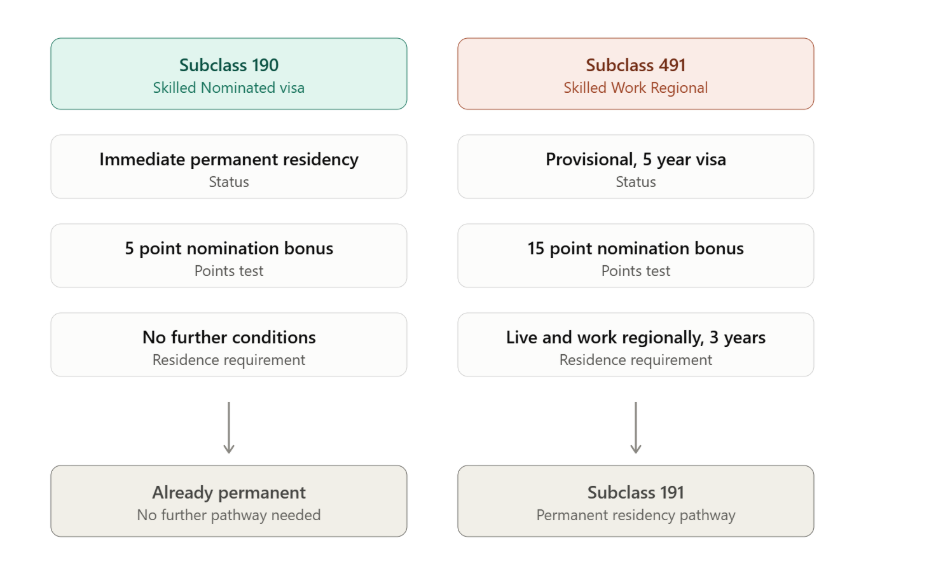
The core legal distinction lies in the residency outcome. The Subclass 190 visa provides immediate permanent residency (PR) (also referred to as permanent residence and full permanent residency), offering migrants long-term security and access to benefits associated with permanent status. In contrast, the Subclass 491 is a five-year work regional provisional visa that requires holders to live and work in a designated regional area before becoming eligible for permanent residency via the Subclass 191 visa. Regional nomination or regional nominations can influence eligibility and processing for the 491 visa. To transition, applicants must meet strict conditions, including maintaining regional residence and achieving the minimum income threshold for at least three consecutive years. Applicants must live, work, and study in designated regional areas and meet all income requirements, including providing tax assessments as evidence. The Subclass 191 is a permanent regional visa, and achieving permanent residency allows migrants to live in Australia permanently. As a result, the Subclass 491 requires a greater initial commitment to regional Australia compared with the Subclass 190.
[success_stories] [/success_stories]
According to the Department of Home Affairs, visa processing timeframes vary depending on demand, priority policies, and the completeness of applications. The Skilled Nominated (Subclass 190) visa and Skilled Work Regional (Provisional) (Subclass 491) visa both face significant waiting periods, with many applicants experiencing processing at the median or 90th percentile timeframe. Processing delays can occur due to incomplete applications or missing required documents.
While historically one visa may have appeared faster, current timeframes can be lengthy for both, making it important for applicants to plan for delays. The application process and individual circumstances, such as occupation and state nomination, can impact visa approval times and risk of visa denial. Applicants should monitor official updates, as the Department of Home Affairs regularly adjusts processing priorities in line with program demand.
To minimize processing delays, it is essential to submit a complete application with all required documents.
Before a visa application can even be lodged, applicants must secure state nomination approval following the submission of an Expression of Interest (EOI), and must select a nominating state or territory government as part of this process. This step adds a hidden layer of time to the overall process, as each state or territory—such as Victoria, South Australia, or New South Wales—or territory government operates under different nomination guidelines and processing speeds. Securing state nomination from an Australian state or territory government is a crucial step in the process, as it is often a key requirement for the Subclass 190 visa and can significantly increase the chances of visa approval. State nomination processing can take weeks or months, and because it is a prerequisite to receiving an invitation, it significantly influences the applicant’s overall waiting experience. For some applicants, regional nomination may also be an option, providing additional pathways through state or family sponsorship in designated regional areas.
[aus_wide_service] [/aus_wide_service]
Even after lodgement, skilled migration applicants can encounter visa application delays that stretch beyond published timeframes. The most common causes stem from factors within the applicant’s control, such as incomplete documentation, inconsistencies in evidence, or errors at submission. Missing a positive skills assessment or not having an occupation on the relevant skilled occupation list can also lead to significant delays. Applicants must also demonstrate English language skills and meet health and character requirements, including providing police clearance certificates. Ensuring that the application is complete at lodgement is therefore essential to minimising preventable delays. Submitting all required skills assessments and maximizing your points score are essential for a smooth process.
A decision-ready application includes all required supporting documentation, such as police certificates, health assessments, and employment evidence, submitted in a consistent and verifiable format. When a case officer must issue a request for further information, the application is taken out of the active processing queue, leading to significant delays. By lodging a complete documentation set from the outset, applicants can maximise the likelihood of their application being processed without interruption.
Some delays arise from checks beyond the applicant’s or lawyer’s control. Health and character checks, including medical examinations and police certificates, are mandatory for all skilled migration visa applicants. In certain cases, national security requirements may also apply, especially for individuals with complex personal backgrounds or extensive international travel. These external processes are legally required and can add substantial time to the overall assessment.
When weighing the Subclass 190 and Subclass 491, applicants face a strategic trade-off between certainty and accessibility. The Subclass 491 offers an additional 15 points in the points test, increasing the chance of receiving an invitation to apply (ITA), but comes with the commitment of regional living and provisional status. Skilled migrants, including international students and skilled professionals, are the primary applicants for these visas. The 190 skilled nominated visa and skilled nominated visa are also important pathways for skilled regional applicants seeking permanent residency. In contrast, the Subclass 190 provides only a 5-point boost but leads directly to permanent residency and allows more flexibility within the sponsoring state. Choosing between the two visas often depends on whether an applicant prioritises faster access to an ITA or the immediate security of PR.
For the 491 visa, regional nominations and living in regional areas are key aspects of the skilled regional migration strategy.
[free_consultation]
If you are interested in getting more information about a visa, get in touch with Australian Migration Lawyers for a consultation.
[/free_consultation]
Processing times fluctuate depending on the Department of Home Affairs’ priorities. While one subclass may have historically been faster, current timeframes for both visas can be lengthy.
It varies significantly by state or territory. Some approvals take only a few weeks, while others can take several months.
A decision-ready application includes all required documentation (police certificates, health assessments, employment evidence) at lodgement, minimising the chance of case officer requests.
Holders must live and work in a designated regional area, and meet income thresholds for at least three years to later apply for the Subclass 191 permanent residency visa. Note that not meeting these requirements or providing incomplete information can result in visa denial.
Migration lawyers ensure legal accuracy, reduce the risk of costly delays, and provide tailored strategic advice on visa pathways and processing times.
After your application is approved, you will receive a visa grant letter from the Department of Home Affairs. This document confirms your visa approval and allows you to enter or remain in Australia legally.
Yes, you can include family members in your application, and in some cases, a family member can sponsor you. For the Subclass 491 visa, an eligible family member or eligible relative living in a designated regional area can act as your sponsor. The eligibility of your family member or relative is crucial for the approval of your application.
Yes, both Subclass 190 and Subclass 491 visas can provide a pathway to permanent residency, allowing you and your family members to settle in Australia permanently.
Offshore and onshore applications for both visas generally follow the same assessment criteria, though processing may be affected by differences in document verification, health examination availability in the applicant's country, and the volume of applications received from a particular location. Applicants should not assume offshore processing is automatically faster or slower than onshore, as this varies by circumstances and Department priorities at the time.
Engaging a skilled visa lawyer in Australia, or consulting a registered migration agent, can make a decisive difference in managing both the strategic choice of visa and the associated processing time. Migration lawyers assist by conducting pre-lodgement documentation reviews, ensuring applications are decision-ready, and managing all correspondence with the Department of Home Affairs and state nomination bodies. With up-to-date insights into current timeframes and program priorities, lawyers can guide applicants toward the most effective skilled visa strategy. If you are considering the Subclass 190 or Subclass 491, contact our team of experienced migration lawyers today for tailored advice and representation, as migration lawyers and agents can provide guidance specific to your individual circumstances.
With 15 years of experience in United States law and public administration, followed by 5 years practising Australian migration law, Nick brings a depth of cross-jurisdictional legal expertise to his work as an Australian migration lawyer.
Nick holds a Bachelor of Arts in Political Science from Florida State University (2000), a Juris Doctorate from St. Thomas University School of Law (2004), and a Master of Public Administration from Florida State University (2007). He has been a member of the Florida Bar since 2006 and the District of Columbia Court of Appeals Bar since 2007, establishing a distinguished international legal career before relocating to Melbourne in 2021.
After completing his Australian legal studies at La Trobe University and The College of Law, he was admitted as an Australian lawyer by the Supreme Court of Victoria in 2022. He subsequently obtained Legal Practitioner Number 5513285, through which he practises in migration law. He is a member of the Law Institute of Victoria.
Nick offers expert guidance on a wide range of migration matters. Having personally navigated the migration process himself, he brings both professional expertise and genuine understanding of what clients experience throughout the process.
Nick serves clients nationally, including in Melbourne, Sydney, Brisbane, Perth, and Adelaide, providing comprehensive support.
He has represented clients in proceedings before the Administrative Review Tribunal (ART), bringing tribunal advocacy experience to complex and contested migration matters.
Outside his professional life, Nick enjoys reading, travel, and exploring Melbourne's coffee culture.
LEGAL DISCLAIMER: Articles and blog posts published by Australian Migration Lawyers provide general information only and do not constitute migration or legal advice. Reading this content does not create a lawyer-client relationship, and any reliance on it is strictly at your own risk. Because migration laws change frequently, please consult a registered Australian Lawyer for professional advice tailored to your specific circumstances before making any migration decisions or applications.
Tell us about your situation, and we will get back to you shortly.
Tell us about your situation, and we will get back to you shortly.
Quick, free tools to help you understand your options before you speak with a migration lawyer — estimate your visa costs or check your PR points.

Estimate Department of Home Affairs charges for employer-sponsored visas — Skills in Demand (subclass 482) nomination and visa, or Employer Nomination Scheme (subclass 186) — including the nomination fee, SAF levy and dependants.
Get Started
Estimate the Home Affairs visa application charge for subclass 189, 190 or 491 — including any partner or children applying with you.
Get Started
See where your score sits against the 65-point minimum for the Subclass 189, 190 and 491 visas, based on age, English ability, work experience and more.
Get StartedTell us a little about your situation, and one of our migration lawyers will get back to you as soon as possible.
Our experienced migration lawyers are here to help —risk-free. Ask about our No Visa, No Fee options and we'll guide you through every step of your journey.


We have created comprehensive visa guides that outline the ins and outs of visa applications. Get yours today.

%402x.svg)