Australia's largest independent migration law firm. Get a FREE Consultation T&C's apply
需要帮助吗?我们每周7天都会提供服务。


请告诉我们您的情况,我们的移民律师会尽快与您联系。
请告诉我们您的情况,我们的移民律师会尽快与您联系。


2026年Telstra“最佳企业奖”提名者

要点总结
Victoria has announced two significant developments ahead of its 2026-27 skilled visa nomination program: the introduction of state-level fees for service and the publication of detailed selection information through the Victorian Points Test. The 2025-26 program is now closed to new Registrations of Interest, and applicants who wish to be considered under the new program year must act when it opens. This article explains what has changed, how selection works, and what these updates mean for skilled professionals considering Victoria as their nomination pathway.
The Victorian Government will charge fees for service when skilled visa applicants submit Registrations of Interest and nomination applications through the Live in Melbourne portal. These changes apply to the Skilled Nominated visa (Subclass 190) and the Skilled Work Regional (Provisional) visa (Subclass 491).
[free_consultation]
如果您想了解有关签证的更多信息,请联系澳大利亚移民律师进行咨询。
[/free_consultation]
The 2026-27 fees are as follows:
Goods and Services Tax of 10% applies where the applicant is physically in Australia at the time of payment. The system calculates and applies this automatically when the application form is completed.
Two points are worth noting for those managing their budget across both state and federal costs. The Registration of Interest fee is charged once per program year: if an applicant withdraws and lodges a new Registration of Interest within the same year, no additional fee applies. The nomination application fee is only payable if the applicant receives an invitation to apply for nomination and then proceeds to submit that application. An applicant who submits a Registration of Interest but is not invited incurs only the Registration of Interest fee.
It is also important to distinguish these state-level fees from the federal visa application charge. From 1 July 2026, the Department of Home Affairs’ base application charge for the main applicant is $6,140 for both the Subclass 190 and the Subclass 491, with additional charges for each family member included in the application. The Victorian fees are separate fees for service payable to the state government, not to the Department of Home Affairs.
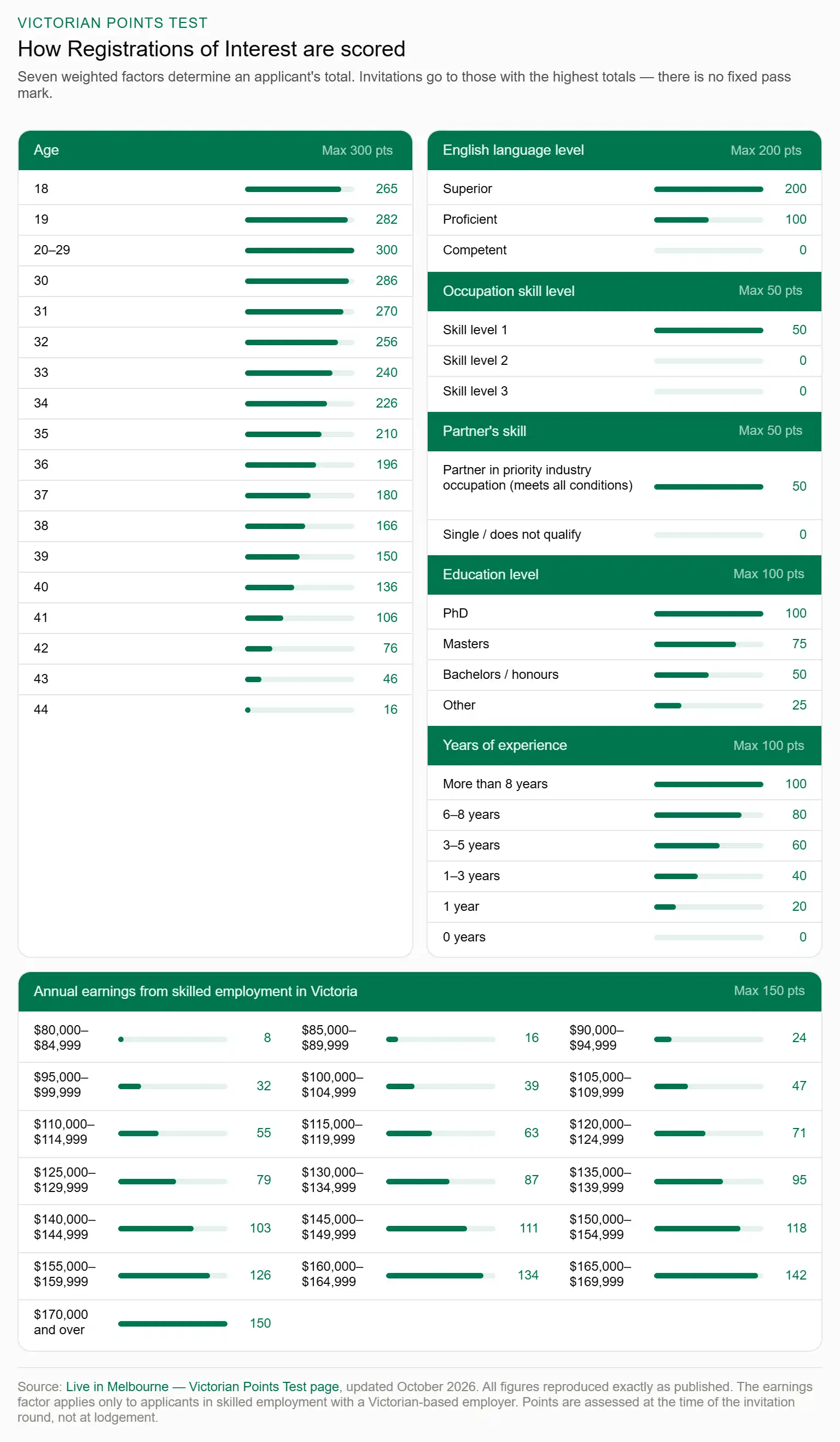
Victoria uses the Victorian Points Test (VPT) to rank all Registrations of Interest in the pool. Seven weighted factors contribute to an applicant’s total: age, English language level, years of experience in the nominated occupation, educational qualification, occupation skill level, partner’s skill (where applicable), and annual earnings from current skilled employment in Victoria (where applicable).
The test places significant weight on age, with applicants aged 20 to 29 attracting the maximum 300 points and points declining with age from 30 onwards. English language proficiency also carries substantial weight, with a Superior rating attracting 200 points compared to zero for Competent. Work experience, education level, and occupation skill level contribute further points, and applicants currently in skilled employment in Victoria earning $80,000 or more may attract additional points based on their annual earnings.
Crucially, the Victorian Points Test does not operate on a fixed pass mark. Unlike the Australian Government’s points test via SkillSelect, which requires a minimum of 65 points, the VPT ranks applicants against one another. Invitations are issued to those with the highest totals in each round, meaning competitiveness depends on the composition of the pool at the time an invitation round is conducted. The Victorian Government cannot advise individual applicants on their likelihood of receiving an invitation or how their score compares with others in the pool.
To estimate your Victorian Points Test total before lodging a Registration of Interest, use the Victorian Points Test Calculator on our website.
[aml_difference][/aml_difference]。
In addition to general competitive selection, Victoria prioritises certain occupations to address critical skills needs. Applicants in these occupations are also ranked within their priority industry or subgroup, giving them a second route to invitation alongside the general competitive pool.
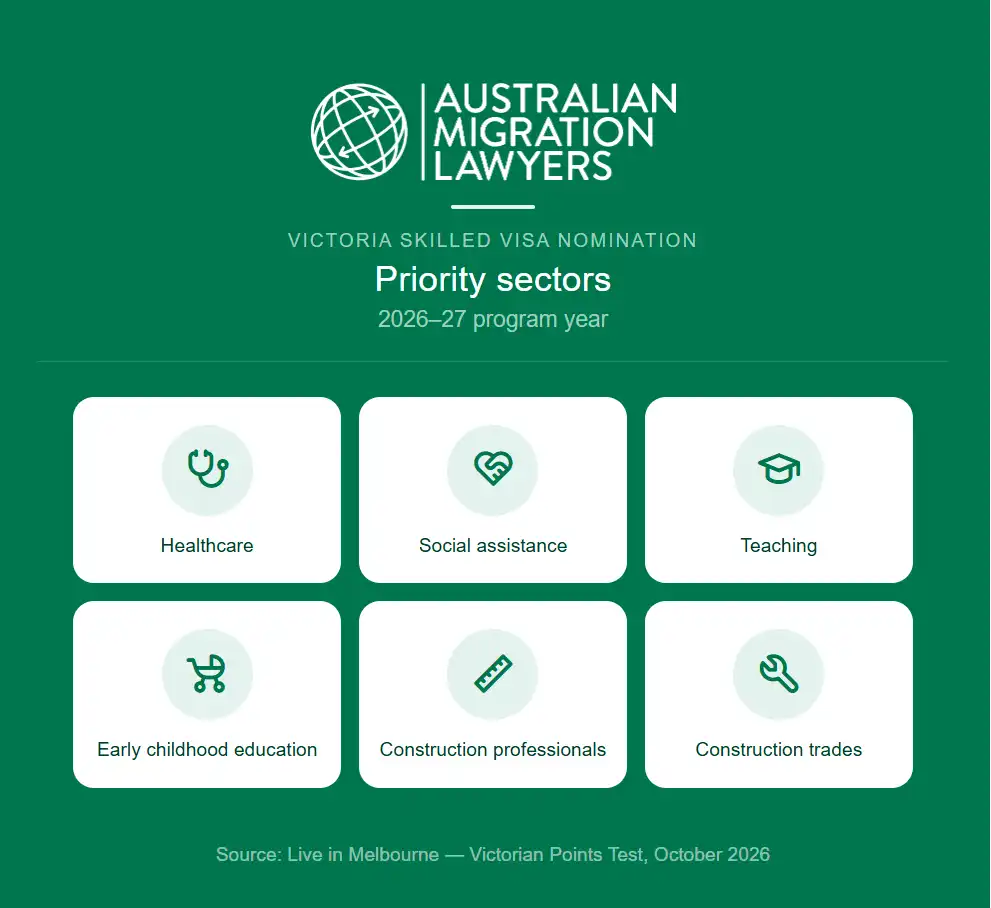
The 2026-27 priority industries are healthcare, social assistance, education, and construction. Within these broad categories, specific subgroups and additional eligibility criteria apply.
Healthcare covers a wide range of occupations, including allied health professionals such as occupational therapists, physiotherapists, speech pathologists, and audiologists; registered nurses across a range of clinical specialisations; medical imaging professionals; and specialist physicians and surgeons across disciplines including cardiology, oncology, psychiatry, and neurosurgery. Midwives and dental technicians also appear on the healthcare list.
Social assistance encompasses clinical psychologists, educational psychologists, organisational psychologists, social workers, and welfare workers.
Education is divided into two subgroups: teachers (covering middle school, secondary school, and special needs teachers) and early childhood education, covering early childhood teachers. Within the early childhood subgroup, Registrations of Interest held by applicants with at least one year of relevant work experience and Proficient or Superior English will be prioritised for invitation.
Construction is similarly divided, with a professionals subgroup covering roles such as construction project managers, surveyors, geotechnical engineers, geophysicists, hydrogeologists, and other spatial scientists, and a trades subgroup covering a broad range of trades including electricians, plumbers, carpenters, bricklayers, and air-conditioning and refrigeration mechanics, among others.
Victoria has indicated that further program details will be published when the 2026-27 program opens, so priorities may be refined. Applicants are encouraged to review the full Victorian Points Test page on the Live in Melbourne website to confirm whether their occupation and subgroup appear in the current priority list before lodging a Registration of Interest. If you are unsure whether your occupation qualifies or how your profile is likely to be assessed, contact Australian Migration Lawyers for guidance specific to your circumstances.
A point of significant practical importance: Registrations of Interest submitted in a previous program year do not automatically carry over into 2026-27. Any applicant who submitted a Registration of Interest under an earlier program and wishes to be considered for Victorian nomination in 2026-27 must log in to the Live in Melbourne portal and submit a new Registration of Interest when the program opens. The Victorian Government has not yet confirmed the opening date for the 2026-27 program; updates will be published on the Live in Melbourne website when available.
The introduction of state-level fees and the publication of selection criteria represent meaningful changes for anyone pursuing Victorian nomination. Applicants need to understand both the financial costs and the competitive dynamics before deciding whether to pursue the Victorian pathway.
The state nomination fees are modest relative to the overall cost of a skilled visa application, but they are now a cost that must be planned for. More significantly, the publication of the Victorian Points Test weightings and priority industries gives applicants a clearer picture of how competitive their profile is likely to be.
Skilled migration is a complex, competitive process and the circumstances that affect an individual’s eligibility, points score, and prospects of nomination require careful assessment. Australian Migration Lawyers is available seven days a week to discuss your circumstances, review your options across state and territory nomination programs, and advise on the most appropriate visa pathway.
[成功案例] [/成功案例]
Our migration lawyers work with skilled applicants at every stage of the process, from confirming eligibility and preparing a strong Expression of Interest through to managing the nomination application and visa lodgement. We understand the nuances of state-specific programs and can advise on how recent changes to Victoria’s program may affect your position relative to other applicants.
If you are considering a Subclass 190 or Subclass 491 visa and want to understand how the 2026-27 Victorian program applies to your circumstances, contact our team today.

尼克拥有15年美国法律和公共行政领域的从业经验,随后又从事了5年澳大利亚移民法实务工作,因此作为一名澳大利亚移民律师,他具备深厚的跨司法管辖区法律专业知识。
尼克拥有佛罗里达州立大学政治学文学学士学位(2000年)、圣托马斯大学法学院法学博士学位(2004年)以及佛罗里达州立大学公共管理硕士学位(2007年)。 他自2006年起成为佛罗里达州律师协会会员,2007年起成为哥伦比亚特区上诉法院律师协会会员,在2021年迁居墨尔本前已建立起杰出的国际法律职业生涯。
在拉筹伯大学和法律学院完成澳大利亚法律学业后,他于2022年获得维多利亚州最高法院授予的澳大利亚律师资格。随后,他获得了执业律师编号5513285,并以此从事移民法领域的执业工作。他是维多利亚州律师协会的会员。
尼克就各类移民事务提供专业指导。由于他本人也曾亲身经历过移民流程,因此不仅具备专业知识,还能真切理解客户在整个过程中所经历的一切。
尼克为全国各地的客户提供服务,包括墨尔本、悉尼、布里斯班、珀斯和阿德莱德,并提供全面的支持。
他曾在行政复审法庭(ART)的审理程序中代理客户,将法庭辩护经验运用到复杂且存在争议的移民事务中。
工作之余,尼克喜欢阅读、旅行,以及探索墨尔本的咖啡文化。
法律免责声明: 澳大利亚移民律师事务所发布的文章和博客帖子仅提供一般性信息,并不构成移民或法律建议。阅读本内容并不建立律师与客户之间的关系,且任何依赖本内容的行为均完全由您自行承担风险。由于移民法律频繁变更,在做出任何移民决定或提交申请之前,请咨询注册的澳大利亚律师,以获取针对您具体情况的专业建议。
告诉我们你的情况,我们会很快给你答复。
告诉我们你的情况,我们会很快给你答复。
Quick, free tools to help you understand your options before you speak with a migration lawyer — estimate your visa costs or check your PR points.

Estimate Department of Home Affairs charges for employer-sponsored visas — Skills in Demand (subclass 482) nomination and visa, or Employer Nomination Scheme (subclass 186) — including the nomination fee, SAF levy and dependants.
Get Started
Estimate the Home Affairs visa application charge for subclass 189, 190 or 491 — including any partner or children applying with you.
Get Started
See where your score sits against the 65-point minimum for the Subclass 189, 190 and 491 visas, based on age, English ability, work experience and more.
Get Started请告诉我们你的情况,我们的移民律师会尽快给你答复。
Our experienced migration lawyers are here to help —risk-free. Ask about our No Visa, No Fee options and we'll guide you through every step of your journey.


我们制作了全面的签证指南,概述签证申请的来龙去脉。立即获取。

%402x.svg)




.svg)