Australia's largest independent migration law firm. Get a FREE Consultation T&C's apply
需要帮助吗?我们每周7天都会提供服务。


请告诉我们您的情况,我们的移民律师会尽快与您联系。
请告诉我们您的情况,我们的移民律师会尽快与您联系。


2026年Telstra“最佳企业奖”提名者

要点总结
On 19 September 2026, Ministerial Direction 122 came into effect, changing the order in which the Department of Home Affairs considers and decides applications for certain permanent and provisional skilled visas. The Minister for Home Affairs, Immigration and Citizenship, the Hon Tony Burke MP, made the Direction under section 499 of the Migration Act 1958. The section allows the Minister to give written directions to decision makers about how they perform their functions. The Department of Home Affairs has updated its published skilled visa processing priorities to reflect the change.
Direction 122 was issued alongside Ministerial Direction 121, which sets processing priorities for temporary skilled visas, including the Skills in Demand (Subclass 482) visa. Together, the two Directions replace every processing priority that applied under Ministerial Direction 119. Direction 119 had commenced on 25 July 2026, replacing Direction 105, and was the first Direction to bring the Skills in Demand (Subclass 482) program into the priority framework. Direction 122 now deals separately with the provisional and permanent skilled streams.
The preamble explains that the Direction is designed to direct processing resources towards industries and occupations of strategic importance to Australia, and, in all other sectors, to favour skilled migrants who already contribute to the Australian community and economy.
[free_consultation]
如果您想了解有关签证的更多信息,请联系澳大利亚移民律师进行咨询。
[/free_consultation]
The Schedule to Direction 122 lists the following visa classes. The Direction uses their formal class names under the Migration Regulations 1994, and the common names used by the Department of Home Affairs are given here:
Note: The Regional Sponsored Migration Scheme (Subclass 187) and Skilled Regional (Provisional) (Subclass 489) visas were replaced from 16 November 2019 by the Skilled Employer Sponsored Regional (Provisional) (Subclass 494) and Skilled Work Regional (Provisional) (Subclass 491) visas. The Subclass 489 is closed to new primary applications, as is the Subclass 187 Direct Entry stream. The Subclass 187 Temporary Residence Transition stream, however, remains open to eligible transitional 457 and 482 workers. The Direction applies to Subclass 187 and 489 applications that remain undecided, including any new Subclass 187 TRT applications. The Skilled Regional (Subclass 887) and Business Innovation and Investment (Permanent) (Subclass 888) visas remain available, but only to people who hold, or have held, certain earlier provisional visas.
Temporary skilled visas, including the Skills in Demand (Subclass 482) visa, are dealt with under Direction 121 and are outside the scope of this article.
Section 6 of Direction 122 sets out four levels of priority. Under section 6(1), decision makers are to follow this order while having due regard to the Government's policy intentions for the size and composition of the Migration Program.
Section 6(3)(a) gives the highest priority to visa applications made by a primary applicant in relation to an occupation in the construction, healthcare, teaching, agriculture, aquaculture, fishing or resources sectors, or an occupation related to Australia's law enforcement or defence interests.
Each sector is defined in section 5(2) of the Direction by reference to Australian and New Zealand Standard Classification of Occupations (ANZSCO) groups and specific occupations. Healthcare, for example, covers the Health Professionals sub-major group and a range of care and support roles, including Aged or Disabled Carer and Personal Care Assistant. Construction includes the construction trades and construction and mining labourers groups, as well as occupations such as Electrician (Special Class). Agriculture, aquaculture and fishing, along with the resources sector, are defined by what the nominated position directly involves, such as primary production or the exploration, extraction and production of minerals, oil, gas or coal.
Law enforcement occupations are limited to ANZSCO Unit Group 4413 (Police) where the applicant is nominated or sponsored by the Australian Federal Police or a state or territory police force. Defence occupations include roles that support the AUKUS trilateral security partnership between Australia, the United Kingdom and the United States, specifically Pillar I (conventionally armed, nuclear-powered submarines) or Pillar II (advanced capability development). They also include roles where the applicant is nominated or sponsored by, or holds a letter of support from, the Australian Defence Force or the Department of Defence, with further conditions applying to applicants who rely on a letter of support.
Section 6(3)(a) does not draw a distinction between onshore and offshore applicants. A primary applicant in a priority sector occupation falls within the highest priority whether they were in or outside Australia when they applied.
Under section 6(3)(b), the next priority is given to all other visa applications where the primary applicant was in Australia when the application was made. This reflects the preamble's focus on skilled migrants who already contribute to Australia.
Section 6(3)(c) places third those primary applicants who were outside Australia when they applied and whose application is not combined with another person's application at any time.
Under section 6(3)(d), all remaining applications fall into the lowest priority. On the structure of section 6(3), this appears to include applications from primary applicants outside Australia whose applications are combined with family members' applications.
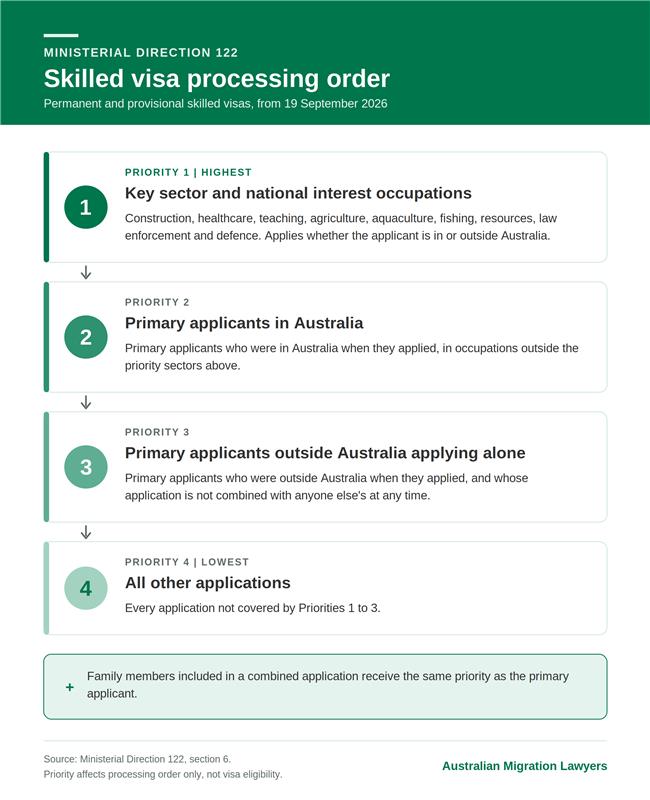
Under section 6(4) of the Direction, family members whose applications are combined with the primary applicant's application, in a way the Migration Regulations 1994 permit, receive the same priority as the primary applicant.
The Direction does not apply to some family member applications at all. Under section 3(2)(d), it does not apply where a person claims to be a member of the family unit of a primary visa holder, did not make a combined application with that primary visa holder, and the primary visa holder was in Australia when they made their own application. Families considering adding members later should get advice on how this may affect the timing of the family member's application.
Section 3(3) provides that Direction 122 applies to visa applications made, but not finally decided, before it commenced, as well as to applications made on or after 19 September 2026. Applicants already waiting on a decision may find that their place in the processing order has moved, either up or down, depending on their occupation and where they were when they applied.
[aml_difference][/aml_difference]。
Section 7 requires a decision maker to depart from the order in section 6 for a particular application if satisfied that it involves compelling circumstances affecting community safety, or the continuity of essential religious, cultural or community services in Australia.
Under section 3(2), the Direction also does not apply to:
Where a section 85 cap limits the number of visas that can be granted in a financial year, section 8 provides that applications covered by the Direction are processed in the same priority order, unless the section 7 exception applies.
Direction 122 governs only the order in which applications are considered. Section 4(4) confirms that it does not change the skilled occupation lists, and that every applicant must still meet the requirements of the Migration Act 1958 and the Migration Regulations 1994 to be granted a visa. Being in a higher priority group does not guarantee a faster outcome or a grant, and no processing timeframe is attached to any priority level.
Application quality still matters. An incomplete application, or one where further information must be requested, can be delayed regardless of its priority. As noted above, an application where it is readily apparent that the visa criteria would not be satisfied falls outside the Direction altogether.
For applicants and employers, the practical questions are whether the nominated occupation falls within a priority sector as defined in the Direction, and where the primary applicant is when the application is lodged. Occupations in the priority sectors sit ahead of all other applications, including onshore applications in other occupations. Outside those sectors, being in Australia at the time of lodgement places an application ahead of offshore applications.
Occupation classification is technical. Careful assessment of the nominated occupation and the position description before lodgement can help avoid an application being placed in a lower priority group than expected.
[成功案例] [/成功案例]
At Australian Migration Lawyers, our team has expertise across skilled and employer sponsored visa pathways. We can assess how Ministerial Direction 122 may affect your application, review whether your nominated occupation falls within a priority sector, and prepare decision-ready applications to reduce avoidable delays. Whether you are a skilled worker planning your next step or an employer sponsoring overseas talent, we can help maximise your chances of success.
Contact Australian Migration Lawyers today to discuss your circumstances with our team. We are available seven days a week.

尼克拥有15年美国法律和公共行政领域的从业经验,随后又从事了5年澳大利亚移民法实务工作,因此作为一名澳大利亚移民律师,他具备深厚的跨司法管辖区法律专业知识。
尼克拥有佛罗里达州立大学政治学文学学士学位(2000年)、圣托马斯大学法学院法学博士学位(2004年)以及佛罗里达州立大学公共管理硕士学位(2007年)。 他自2006年起成为佛罗里达州律师协会会员,2007年起成为哥伦比亚特区上诉法院律师协会会员,在2021年迁居墨尔本前已建立起杰出的国际法律职业生涯。
在拉筹伯大学和法律学院完成澳大利亚法律学业后,他于2022年获得维多利亚州最高法院授予的澳大利亚律师资格。随后,他获得了执业律师编号5513285,并以此从事移民法领域的执业工作。他是维多利亚州律师协会的会员。
尼克就各类移民事务提供专业指导。由于他本人也曾亲身经历过移民流程,因此不仅具备专业知识,还能真切理解客户在整个过程中所经历的一切。
尼克为全国各地的客户提供服务,包括墨尔本、悉尼、布里斯班、珀斯和阿德莱德,并提供全面的支持。
他曾在行政复审法庭(ART)的审理程序中代理客户,将法庭辩护经验运用到复杂且存在争议的移民事务中。
工作之余,尼克喜欢阅读、旅行,以及探索墨尔本的咖啡文化。
法律免责声明: 澳大利亚移民律师事务所发布的文章和博客帖子仅提供一般性信息,并不构成移民或法律建议。阅读本内容并不建立律师与客户之间的关系,且任何依赖本内容的行为均完全由您自行承担风险。由于移民法律频繁变更,在做出任何移民决定或提交申请之前,请咨询注册的澳大利亚律师,以获取针对您具体情况的专业建议。
告诉我们你的情况,我们会很快给你答复。
告诉我们你的情况,我们会很快给你答复。
请告诉我们你的情况,我们的移民律师会尽快给你答复。
Our experienced migration lawyers are here to help —risk-free. Ask about our No Visa, No Fee options and we'll guide you through every step of your journey.


我们制作了全面的签证指南,概述签证申请的来龙去脉。立即获取。

%402x.svg)




.svg)