Australia's largest independent migration law firm. Get a FREE Consultation T&C's apply
Need help? We are available 7 days a week.


Tell us about your situation, and our immigration lawyers will get back to you shortly.
Tell us about your situation, and our immigration lawyers will get back to you shortly.


2026 Telstra Best of Business Awards Nominee


Winner of Most Trusted Australian Migration Law Firm 2023-2026

Ranked 1st for migration law in 2023, 2024 & 2025

Ranked in the top migration lawyers 2023, 2024, 2025 & 2026

Ranked the best migration law firm 2024 & 2025

.svg)
Decision-ready applications, prepared by lawyers.
No Visa, No Fee options available.*
Free initial consultation (T&Cs apply).
Key Takeaways
Victoria has announced two significant developments ahead of its 2026-27 skilled visa nomination program: the introduction of state-level fees for service and the publication of detailed selection information through the Victorian Points Test. The 2025-26 program is now closed to new Registrations of Interest, and applicants who wish to be considered under the new program year must act when it opens. This article explains what has changed, how selection works, and what these updates mean for skilled professionals considering Victoria as their nomination pathway.
The Victorian Government will charge fees for service when skilled visa applicants submit Registrations of Interest and nomination applications through the Live in Melbourne portal. These changes apply to the Skilled Nominated visa (Subclass 190) and the Skilled Work Regional (Provisional) visa (Subclass 491).
[free_consultation]
If you are interested in getting more information about a visa, get in touch with Australian Migration Lawyers for a consultation.
[/free_consultation]
The 2026-27 fees are as follows:
Goods and Services Tax of 10% applies where the applicant is physically in Australia at the time of payment. The system calculates and applies this automatically when the application form is completed.
Two points are worth noting for those managing their budget across both state and federal costs. The Registration of Interest fee is charged once per program year: if an applicant withdraws and lodges a new Registration of Interest within the same year, no additional fee applies. The nomination application fee is only payable if the applicant receives an invitation to apply for nomination and then proceeds to submit that application. An applicant who submits a Registration of Interest but is not invited incurs only the Registration of Interest fee.
It is also important to distinguish these state-level fees from the federal visa application charge. From 1 July 2026, the Department of Home Affairs’ base application charge for the main applicant is $6,140 for both the Subclass 190 and the Subclass 491, with additional charges for each family member included in the application. The Victorian fees are separate fees for service payable to the state government, not to the Department of Home Affairs.
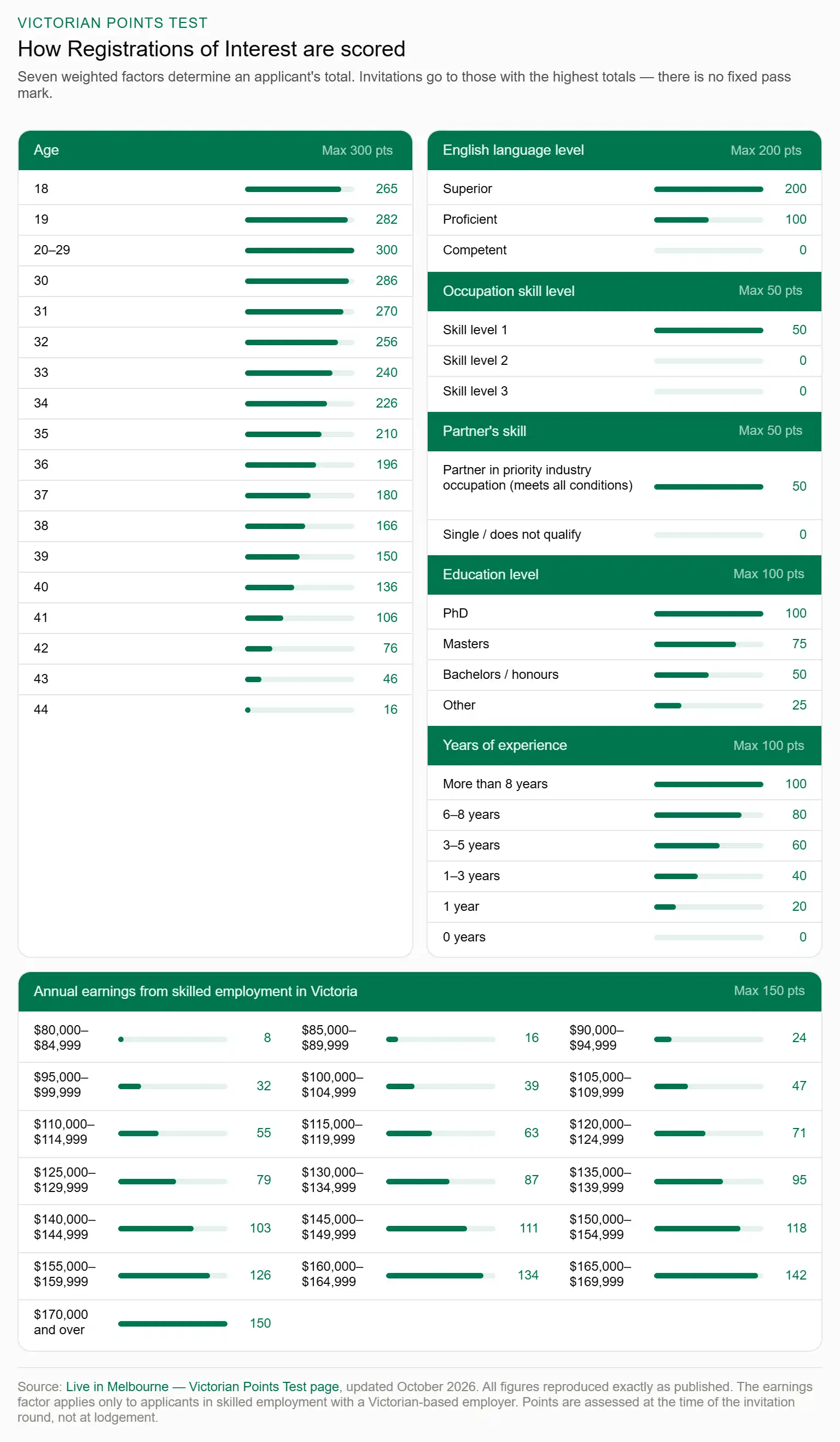
Victoria uses the Victorian Points Test (VPT) to rank all Registrations of Interest in the pool. Seven weighted factors contribute to an applicant’s total: age, English language level, years of experience in the nominated occupation, educational qualification, occupation skill level, partner’s skill (where applicable), and annual earnings from current skilled employment in Victoria (where applicable).
The test places significant weight on age, with applicants aged 20 to 29 attracting the maximum 300 points and points declining with age from 30 onwards. English language proficiency also carries substantial weight, with a Superior rating attracting 200 points compared to zero for Competent. Work experience, education level, and occupation skill level contribute further points, and applicants currently in skilled employment in Victoria earning $80,000 or more may attract additional points based on their annual earnings.
Crucially, the Victorian Points Test does not operate on a fixed pass mark. Unlike the Australian Government’s points test via SkillSelect, which requires a minimum of 65 points, the VPT ranks applicants against one another. Invitations are issued to those with the highest totals in each round, meaning competitiveness depends on the composition of the pool at the time an invitation round is conducted. The Victorian Government cannot advise individual applicants on their likelihood of receiving an invitation or how their score compares with others in the pool.
To estimate your Victorian Points Test total before lodging a Registration of Interest, use the Victorian Points Test Calculator on our website.
[aml_difference][/aml_difference]
In addition to general competitive selection, Victoria prioritises certain occupations to address critical skills needs. Applicants in these occupations are also ranked within their priority industry or subgroup, giving them a second route to invitation alongside the general competitive pool.
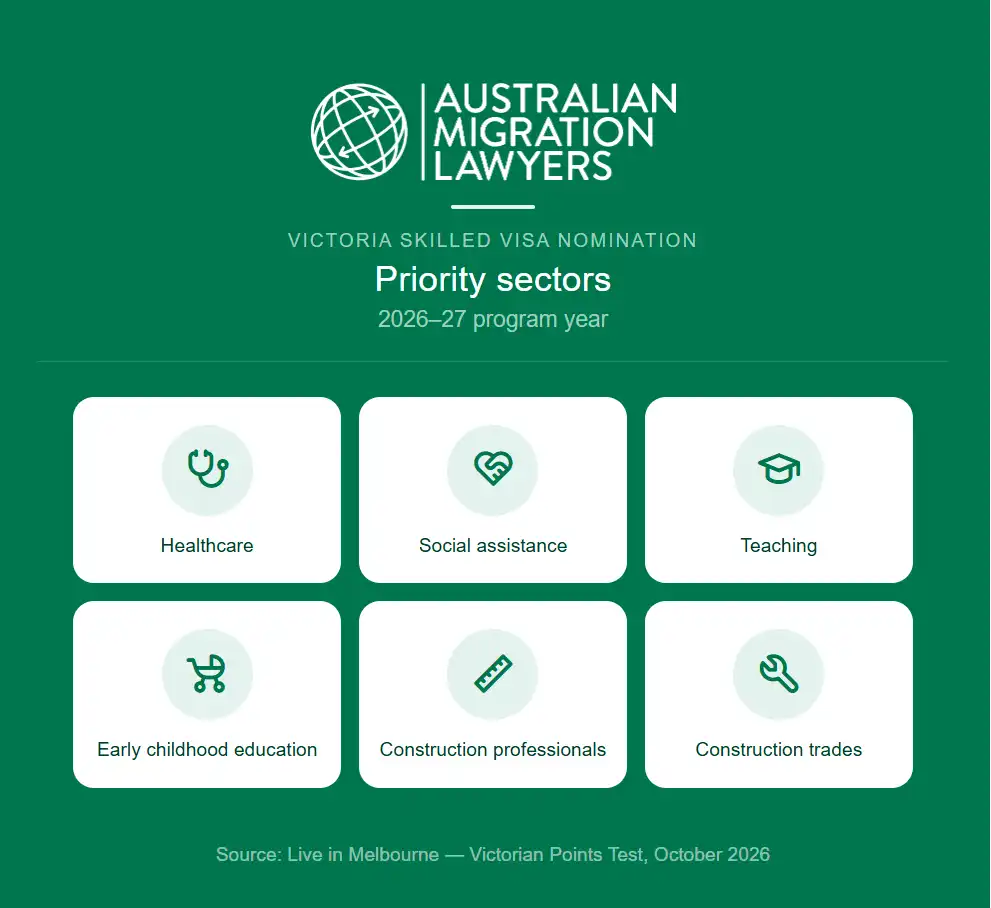
The 2026-27 priority industries are healthcare, social assistance, education, and construction. Within these broad categories, specific subgroups and additional eligibility criteria apply.
Healthcare covers a wide range of occupations, including allied health professionals such as occupational therapists, physiotherapists, speech pathologists, and audiologists; registered nurses across a range of clinical specialisations; medical imaging professionals; and specialist physicians and surgeons across disciplines including cardiology, oncology, psychiatry, and neurosurgery. Midwives and dental technicians also appear on the healthcare list.
Social assistance encompasses clinical psychologists, educational psychologists, organisational psychologists, social workers, and welfare workers.
Education is divided into two subgroups: teachers (covering middle school, secondary school, and special needs teachers) and early childhood education, covering early childhood teachers. Within the early childhood subgroup, Registrations of Interest held by applicants with at least one year of relevant work experience and Proficient or Superior English will be prioritised for invitation.
Construction is similarly divided, with a professionals subgroup covering roles such as construction project managers, surveyors, geotechnical engineers, geophysicists, hydrogeologists, and other spatial scientists, and a trades subgroup covering a broad range of trades including electricians, plumbers, carpenters, bricklayers, and air-conditioning and refrigeration mechanics, among others.
Victoria has indicated that further program details will be published when the 2026-27 program opens, so priorities may be refined. Applicants are encouraged to review the full Victorian Points Test page on the Live in Melbourne website to confirm whether their occupation and subgroup appear in the current priority list before lodging a Registration of Interest. If you are unsure whether your occupation qualifies or how your profile is likely to be assessed, contact Australian Migration Lawyers for guidance specific to your circumstances.
A point of significant practical importance: Registrations of Interest submitted in a previous program year do not automatically carry over into 2026-27. Any applicant who submitted a Registration of Interest under an earlier program and wishes to be considered for Victorian nomination in 2026-27 must log in to the Live in Melbourne portal and submit a new Registration of Interest when the program opens. The Victorian Government has not yet confirmed the opening date for the 2026-27 program; updates will be published on the Live in Melbourne website when available.
The introduction of state-level fees and the publication of selection criteria represent meaningful changes for anyone pursuing Victorian nomination. Applicants need to understand both the financial costs and the competitive dynamics before deciding whether to pursue the Victorian pathway.
The state nomination fees are modest relative to the overall cost of a skilled visa application, but they are now a cost that must be planned for. More significantly, the publication of the Victorian Points Test weightings and priority industries gives applicants a clearer picture of how competitive their profile is likely to be.
Skilled migration is a complex, competitive process and the circumstances that affect an individual’s eligibility, points score, and prospects of nomination require careful assessment. Australian Migration Lawyers is available seven days a week to discuss your circumstances, review your options across state and territory nomination programs, and advise on the most appropriate visa pathway.
[success_stories] [/success_stories]
Our migration lawyers work with skilled applicants at every stage of the process, from confirming eligibility and preparing a strong Expression of Interest through to managing the nomination application and visa lodgement. We understand the nuances of state-specific programs and can advise on how recent changes to Victoria’s program may affect your position relative to other applicants.
If you are considering a Subclass 190 or Subclass 491 visa and want to understand how the 2026-27 Victorian program applies to your circumstances, contact our team today.
With 15 years of experience in United States law and public administration, followed by 5 years practising Australian migration law, Nick brings a depth of cross-jurisdictional legal expertise to his work as an Australian migration lawyer.
Nick holds a Bachelor of Arts in Political Science from Florida State University (2000), a Juris Doctorate from St. Thomas University School of Law (2004), and a Master of Public Administration from Florida State University (2007). He has been a member of the Florida Bar since 2006 and the District of Columbia Court of Appeals Bar since 2007, establishing a distinguished international legal career before relocating to Melbourne in 2021.
After completing his Australian legal studies at La Trobe University and The College of Law, he was admitted as an Australian lawyer by the Supreme Court of Victoria in 2022. He subsequently obtained Legal Practitioner Number 5513285, through which he practises in migration law. He is a member of the Law Institute of Victoria.
Nick offers expert guidance on a wide range of migration matters. Having personally navigated the migration process himself, he brings both professional expertise and genuine understanding of what clients experience throughout the process.
Nick serves clients nationally, including in Melbourne, Sydney, Brisbane, Perth, and Adelaide, providing comprehensive support.
He has represented clients in proceedings before the Administrative Review Tribunal (ART), bringing tribunal advocacy experience to complex and contested migration matters.
Outside his professional life, Nick enjoys reading, travel, and exploring Melbourne's coffee culture.
LEGAL DISCLAIMER: Articles and blog posts published by Australian Migration Lawyers provide general information only and do not constitute migration or legal advice. Reading this content does not create a lawyer-client relationship, and any reliance on it is strictly at your own risk. Because migration laws change frequently, please consult a registered Australian Lawyer for professional advice tailored to your specific circumstances before making any migration decisions or applications.
Tell us about your situation, and we will get back to you shortly.
Tell us about your situation, and we will get back to you shortly.
Quick, free tools to help you understand your options before you speak with a migration lawyer — estimate your visa costs or check your PR points.

Estimate Department of Home Affairs charges for employer-sponsored visas — Skills in Demand (subclass 482) nomination and visa, or Employer Nomination Scheme (subclass 186) — including the nomination fee, SAF levy and dependants.
Get Started
Estimate the Home Affairs visa application charge for subclass 189, 190 or 491 — including any partner or children applying with you.
Get Started
See where your score sits against the 65-point minimum for the Subclass 189, 190 and 491 visas, based on age, English ability, work experience and more.
Get StartedTell us a little about your situation, and one of our migration lawyers will get back to you as soon as possible.
Our experienced migration lawyers are here to help —risk-free. Ask about our No Visa, No Fee options and we'll guide you through every step of your journey.


We have created comprehensive visa guides that outline the ins and outs of visa applications. Get yours today.

%402x.svg)