Australia's largest independent migration law firm. Get a FREE Consultation T&C's apply
Need help? We are available 7 days a week.


Tell us about your situation, and our immigration lawyers will get back to you shortly.
Tell us about your situation, and our immigration lawyers will get back to you shortly.


2026 Telstra Best of Business Awards Nominee

.webp)

Winner of Most Trusted Australian Migration Law Firm 2023-2026

Ranked 1st for migration law in 2023, 2024 & 2025

Ranked in the top migration lawyers 2023, 2024, 2025 & 2026

Ranked the best migration law firm 2024 & 2025

.svg)
Decision-ready applications, prepared by lawyers.
No Visa, No Fee options available.*
Free initial consultation (T&Cs apply).
Key Takeaways
Australia’s skilled migration program for 2025–26 is taking shape as states and territories begin releasing their allocation numbers. The Australian Government, through the Department of Home Affairs, sets the overall skilled migration program and allocates nomination places to each state and territory. Several jurisdictions have now confirmed their skilled visa places, and, as of the most recent updates, all states and territories, including Western Australia and South Australia, have now received their final allocations for the year. For applicants planning a pathway through the Subclass 190 or Subclass 491 visas, understanding these updates is essential to shaping a realistic and strategic migration plan.
The total skilled migration allocation is divided between different visa subclasses, such as Subclass 190 and Subclass 491. Nomination allocations determine the number of nominations states and territories can make, but do not guarantee visa grants. The skilled migration program is part of Australia’s permanent migration program. Meeting nomination criteria, including demonstrating relevant skills and obtaining a positive skills assessment, is crucial for a successful application. Submitting a current and competitive Expression of Interest (EOI) is also an important step in the nomination process.
For context, the national total for state and territory nomination places in 2025 to 26 is 20,350, made up of 12,850 places for the Subclass 190 and 7,500 places for the Subclass 491. This sits within Australia's overall permanent Migration Program for 2025-26, which totals 185,000 places across all streams, with the skilled stream, including state and territory nominated, employer sponsored, and points-tested independent visas, making up the majority of that figure.
In this article, Australian Migration Lawyers outlines the latest announcements across New South Wales, the ACT, Tasmania, the Northern Territory, Western Australia, South Australia, Victoria and Queensland.
New South Wales has confirmed a total allocation of 3,600 places for the 2025–26 program year. The Department of Home Affairs provides the full allocations to NSW for state nomination each year.
These are the full allocations for the 2025–26 program year.
Applicants must meet specific nomination requirements for NSW state nomination.
These figures were confirmed by the Migration Institute of Australia. NSW is expected to release further detail on invitation schedules, occupation priorities and eligibility settings once internal planning is finalised.
NSW historically remains one of the most competitive states, and applicants are encouraged to submit a well-prepared Expression of Interest (EOI) and to closely monitor upcoming announcements and official updates.
[free_consultation]
If you are interested in getting more information about a visa, get in touch with Australian Migration Lawyers for a consultation.
[/free_consultation]
The Australian Capital Territory has received 1,600 skilled migration places for the 2025–26 year. The ACT is a separate jurisdiction within Australia, and it operates its own skilled migration program with a specific nomination allocation and unique nomination criteria.
The ACT Government is currently scheduling its next invitation round, with details to be published on its website once confirmed. As always, the ACT will operate through regular invitation rounds, offering clear ongoing guidance throughout the year.
Applicants should stay informed by regularly checking the ACT Government’s migration website for updates on nomination allocation, nomination criteria, and invitation trends.
Western Australia's final allocation for 2025 to 26 has now been confirmed at 3,400 total places, one of the largest allocations of any state. This was confirmed by the Department of Home Affairs on 18 November 2025. With its full allocation now in hand, WA has moved to issuing invitations monthly rather than through a single interim round, and held a major invitation round on 5 December 2025, issuing 1,058 Subclass 190 and 742 Subclass 491 invitations in that round alone.
Applicants should continue monitoring WA’s official migration website for updates on final allocations, invitation schedules and any changes to eligibility criteria. Further details on final allocations and upcoming invitation rounds will be published on the official website.
[aus_wide_service] [/aus_wide_service]
Tasmania has confirmed 1,850 skilled migration places for 2025–26 as part of its annual nomination allocation. This allocation is available to skilled professionals both within Tasmania and overseas, providing opportunities for international applicants as well.
Migration Tasmania has already begun issuing invitations to skilled professionals through weekly nomination rounds as part of its nomination process. Weekly invitations are issued and updates published online will include:
With the program now active, applicants can expect regular and transparent reporting.
Tasmania received an additional 450 interim places, 300 for the Subclass 190 and 150 for the Subclass 491, ahead of these weekly rounds being confirmed, and its transparent weekly reporting model has since become a useful benchmark for how other states publish invitation round data.
The Northern Territory has confirmed 1,650 skilled migration places, reflecting a 50-place increase from the previous program year. The Department of Home Affairs allocates these skilled migration places to the Northern Territory, influencing the number of available visas each year.
The NT Government has also announced that its nomination program will open on 24 November 2025 for all onshore and offshore streams. Full program details and eligibility guidance are now available through the NT Government’s migration portal. Applicants must meet specific nomination requirements for the Northern Territory’s skilled migration program.
Separately from these skilled visa nomination places, the Northern Territory also operates its own Designated Area Migration Agreement, offering employer sponsored concessions to standard 482, 494 and 186 visa requirements for eligible NT employers. This is a distinct pathway from the state nomination places discussed here, and applicants interested in an NT employer sponsored option should look into the NT DAMA separately.
[aml_difference][/aml_difference]
South Australia's final allocation for the 2025 to 26 General Skilled Migration Program has been confirmed at 2,250 total nomination places, up from the earlier interim figures.
Victoria has finalised its allocation, confirming 3,400 skilled migration places for 2025–26. Victoria’s allocation is aimed at attracting skilled migrants through skilled visas such as Subclass 190 and Subclass 491. Applicants must complete a skills assessment as part of the nomination process.
Victoria has confirmed that existing ROIs remain valid for consideration in the new program year. Applicants only need to submit a new ROI if the information in their existing submission has changed. Updated guidance on invitation schedules will be released by the Victorian Government in due course.
Queensland has now opened its State Nominated Migration Program with 2,600 places for 2025–26, more than double the previous year’s allocation. Queensland’s nomination allocation is designed to attract skilled professionals with in-demand skills to support the state’s economic growth.
This substantial increase in nomination allocation aims to address shortages across key sectors including construction, healthcare, manufacturing and regional industries.
Applicants should review:
If you have previously submitted an ROI for Subclass 491 but also meet Subclass 190 criteria, you may lodge a new ROI for Subclass 190. Only your most recent ROI will be considered in selection rounds.
[success_stories] [/success_stories]
Here is how the state and territory allocations compare against the national total.
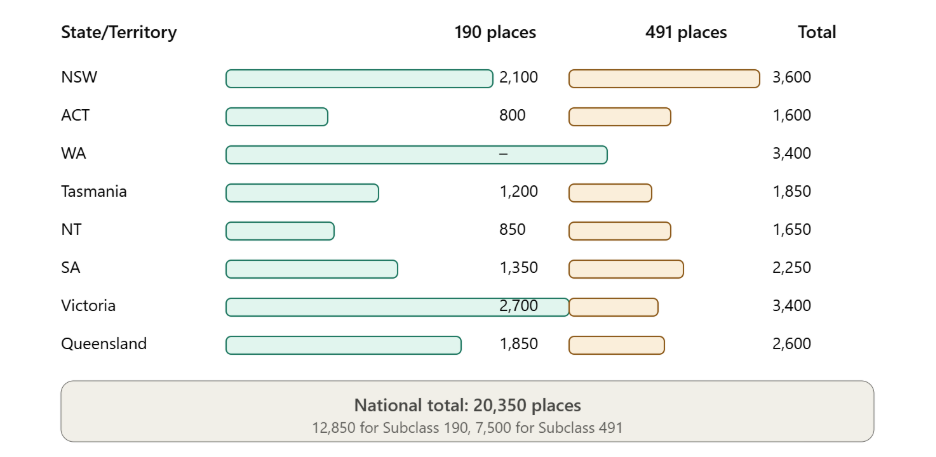
All states and territories have now confirmed their final numbers for the 2025 to 26 program year, including Western Australia and South Australia, both of which finalised their allocations shortly after initially operating on interim figures.
The nomination allocation refers to the number of skilled migration places each state can nominate for the program year.
This depends on the state. For example, Victoria does not require a new ROI unless your information has changed. Queensland allows new ROIs if you now meet Subclass 190 requirements.
Keep in mind that submitting an Expression of Interest (EOI) is required for state nomination, and your EOI must meet the latest nomination requirements for your chosen state or territory.
NSW remains one of Australia’s most competitive jurisdictions due to high demand and limited places. As a jurisdiction, NSW enforces strict nomination criteria for skilled migration visas, making it essential for applicants to understand and meet these requirements.
WA's final allocation of 3,400 places was confirmed by the Department of Home Affairs on 18 November 2025, and the state has since been issuing invitations monthly.
Tasmania has already begun weekly nomination rounds with transparent weekly reporting. As part of its skilled migration program, Tasmania conducts weekly invitations for Registrations of Interest (ROIs)
The 20,350 state and territory nomination places for 2025 to 26 sit within Australia's broader permanent Migration Program of 185,000 places for the year. State and territory nomination is one of several skilled migration pathways alongside the points-tested independent Subclass 189 and employer sponsored visas, all of which draw from the same overall skilled stream allocation.
With 15 years of experience in United States law and public administration, followed by 5 years practising Australian migration law, Nick brings a depth of cross-jurisdictional legal expertise to his work as an Australian migration lawyer.
Nick holds a Bachelor of Arts in Political Science from Florida State University (2000), a Juris Doctorate from St. Thomas University School of Law (2004), and a Master of Public Administration from Florida State University (2007). He has been a member of the Florida Bar since 2006 and the District of Columbia Court of Appeals Bar since 2007, establishing a distinguished international legal career before relocating to Melbourne in 2021.
After completing his Australian legal studies at La Trobe University and The College of Law, he was admitted as an Australian lawyer by the Supreme Court of Victoria in 2022. He subsequently obtained Legal Practitioner Number 5513285, through which he practises in migration law. He is a member of the Law Institute of Victoria.
Nick offers expert guidance on a wide range of migration matters. Having personally navigated the migration process himself, he brings both professional expertise and genuine understanding of what clients experience throughout the process.
Nick serves clients nationally, including in Melbourne, Sydney, Brisbane, Perth, and Adelaide, providing comprehensive support.
He has represented clients in proceedings before the Administrative Review Tribunal (ART), bringing tribunal advocacy experience to complex and contested migration matters.
Outside his professional life, Nick enjoys reading, travel, and exploring Melbourne's coffee culture.
LEGAL DISCLAIMER: Articles and blog posts published by Australian Migration Lawyers provide general information only and do not constitute migration or legal advice. Reading this content does not create a lawyer-client relationship, and any reliance on it is strictly at your own risk. Because migration laws change frequently, please consult a registered Australian Lawyer for professional advice tailored to your specific circumstances before making any migration decisions or applications.
Tell us about your situation, and we will get back to you shortly.
Tell us about your situation, and we will get back to you shortly.
Quick, free tools to help you understand your options before you speak with a migration lawyer — estimate your visa costs or check your PR points.

Estimate Department of Home Affairs charges for employer-sponsored visas — Skills in Demand (subclass 482) nomination and visa, or Employer Nomination Scheme (subclass 186) — including the nomination fee, SAF levy and dependants.
Get Started
Estimate the Home Affairs visa application charge for subclass 189, 190 or 491 — including any partner or children applying with you.
Get Started
See where your score sits against the 65-point minimum for the Subclass 189, 190 and 491 visas, based on age, English ability, work experience and more.
Get StartedTell us a little about your situation, and one of our migration lawyers will get back to you as soon as possible.
Our experienced migration lawyers are here to help —risk-free. Ask about our No Visa, No Fee options and we'll guide you through every step of your journey.


We have created comprehensive visa guides that outline the ins and outs of visa applications. Get yours today.

%402x.svg)