Australia's largest independent migration law firm. Get a FREE Consultation T&C's apply
Need help? We are available 7 days a week.


Tell us about your situation, and our immigration lawyers will get back to you shortly.
Tell us about your situation, and our immigration lawyers will get back to you shortly.


2026 Telstra Best of Business Awards Nominee

.webp)

Winner of Most Trusted Australian Migration Law Firm 2023-2026

Ranked 1st for migration law in 2023, 2024 & 2025

Ranked in the top migration lawyers 2023, 2024, 2025 & 2026

Ranked the best migration law firm 2024 & 2025

.svg)
Decision-ready applications, prepared by lawyers.
No Visa, No Fee options available.*
Free initial consultation (T&Cs apply).
Key Takeaways
Becoming an Australian citizen is a significant milestone, representing a celebration of your commitment, belonging, and contribution to this nation. However, the path to citizenship is not without its hurdles. One key step in the application process is passing the Australian citizenship test. While many applicants succeed with proper preparation, others encounter delays or are unsuccessful due to avoidable mistakes.
To support your journey, we explore the most common pitfalls that applicants face and provide practical strategies to help you navigate the test and application process with confidence. With the right approach, you can maximise your prospects of success.
Before you even book your test, it is essential to confirm you meet the general residency criteria. From our experience, this is a common and costly oversight. For most applicants, this includes:
Submitting an application before meeting these requirements will result in an automatic refusal. To avoid this, we recommend you use the Department of Home Affairs’ Residence Calculator to determine your eligibility before applying.
Missing or incorrect paperwork is a common cause of delays or outright rejections in a citizenship application. Essential documents often include your full birth certificate, a valid passport, and evidence of residency, such as visa grant notices and travel records. You will also need to provide identity documents and potentially police clearances.
It is crucial to ensure all information is consistent across documents and that nothing is missing or expired. An error here can set your application back significantly.
[free_consultation]
If you are interested in getting more information about a visa, get in touch with Australian Migration Lawyers for a consultation.
[/free_consultation]
Every applicant must satisfy Australia’s character standards. These checks are crucial in determining your suitability for citizenship. Common errors include:
Even minor omissions can raise red flags. Be honest and proactive. If you are unsure whether something should be declared, it is always better to disclose it upfront than risk a failed application later. For complex situations, the guidance of Australian Migration Lawyers can be invaluable.
The Australian Citizenship Test is designed to assess your knowledge of Australia’s history, democratic principles, government, laws, and core values. Many applicants assume it will be simple and fail to prepare adequately.
You should aim to thoroughly study the official resource, Australian Citizenship: Our Common Bond. This booklet is available in 40 languages and is the foundation of all test questions. You can also use official practice tests, listen to the Our Common Bond podcast, and access the AMEP’s online citizenship modules if eligible.
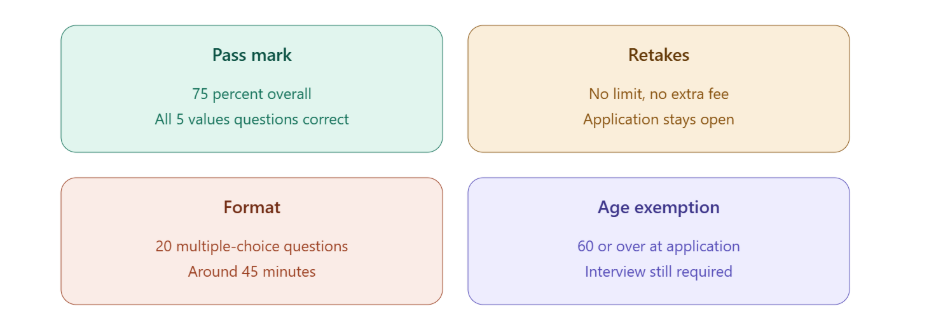
A minimum score of 75% is required, and you must correctly answer all five questions on Australian values.
There is no limit on how many times you can retake the citizenship test, and no additional fee for doing so. Your citizenship application stays open while you prepare and rebook, you do not need to reapply or pay again, no matter how many attempts it takes. That said, each failed attempt requires you to rebook a new appointment through ImmiAccount, which can meaningfully delay your overall timeline, so it is worth treating every attempt as your best attempt rather than rushing back in unprepared.
[aml_difference][/aml_difference]
Another frequent error is misreading or rushing through the test. Questions may be worded in formal or unfamiliar English, especially for those who speak English as a second language. Mistakes often occur due to:
To combat this, practise with resources that use formal English and take your time during the test. There is no reward for speed, so accuracy is key.
The test itself is 20 multiple-choice questions, generally allowing 45 minutes. If you have a disability, hearing or vision impairment, or literacy difficulty, you can request reasonable adjustments from the Department before your test, such as the Assisted Test format, which reads questions aloud and allows additional time.
Australian citizenship is not just about knowing facts. It is about embracing the values that underpin Australian society: freedom, equality, respect, and the rule of law.
Many applicants perform poorly on the Australian values questions because they have not taken the time to understand these principles. This section of the test is non-negotiable: all five questions must be answered correctly to pass.
Make sure you read the relevant sections in Our Common Bond thoroughly and reflect on what these values mean in practice.
Success in the citizenship test is not just about what you know, it is also about how you take the test. Applicants often neglect practical strategies, such as:
Approach the test like any other important exam. Stay calm, pace yourself, and use logic where needed. This practical mindset can make a real difference.
For non-native English speakers, the test’s vocabulary can be a significant hurdle. Complex or formal phrasing may obscure otherwise simple questions. To overcome this:
The better your grasp of the English language, the more confidently you can approach the test.
[success_stories] [/success_stories]
You are generally exempt from the citizenship test if you are under 18 at the time of application, aged 60 or over at the time of application, or have a permanent physical or mental incapacity that prevents you from understanding the test or demonstrating the required knowledge. Being exempt does not mean skipping the citizenship process altogether, exempt applicants still generally attend an interview to confirm identity and eligibility.
Here is a quick overview of the test itself.
If you need to reschedule, this must generally be done before your original appointment time, through ImmiAccount or by contacting the Department directly. If you miss your appointment altogether without rescheduling in advance, this is treated as a non-attendance rather than a straightforward reschedule, and may involve a different process. If you are unwell on the day, contact your test centre directly and update ImmiAccount as soon as possible, and keep any medical documentation in case it is requested.
While many applicants complete the citizenship process independently, getting professional guidance can significantly reduce stress and the risk of error.
A lawyer with expertise in migration law can:
If you would like assistance with your citizenship journey, Australian Migration Lawyers is here to help. Our team of professionals can guide you through the process, reduce the risk of delays, and give you the best possible chance at success. Contact us today for tailored advice on your citizenship application.
With 15 years of experience in United States law and public administration, followed by 5 years practising Australian migration law, Nick brings a depth of cross-jurisdictional legal expertise to his work as an Australian migration lawyer.
Nick holds a Bachelor of Arts in Political Science from Florida State University (2000), a Juris Doctorate from St. Thomas University School of Law (2004), and a Master of Public Administration from Florida State University (2007). He has been a member of the Florida Bar since 2006 and the District of Columbia Court of Appeals Bar since 2007, establishing a distinguished international legal career before relocating to Melbourne in 2021.
After completing his Australian legal studies at La Trobe University and The College of Law, he was admitted as an Australian lawyer by the Supreme Court of Victoria in 2022. He subsequently obtained Legal Practitioner Number 5513285, through which he practises in migration law. He is a member of the Law Institute of Victoria.
Nick offers expert guidance on a wide range of migration matters. Having personally navigated the migration process himself, he brings both professional expertise and genuine understanding of what clients experience throughout the process.
Nick serves clients nationally, including in Melbourne, Sydney, Brisbane, Perth, and Adelaide, providing comprehensive support.
He has represented clients in proceedings before the Administrative Review Tribunal (ART), bringing tribunal advocacy experience to complex and contested migration matters.
Outside his professional life, Nick enjoys reading, travel, and exploring Melbourne's coffee culture.
LEGAL DISCLAIMER: Articles and blog posts published by Australian Migration Lawyers provide general information only and do not constitute migration or legal advice. Reading this content does not create a lawyer-client relationship, and any reliance on it is strictly at your own risk. Because migration laws change frequently, please consult a registered Australian Lawyer for professional advice tailored to your specific circumstances before making any migration decisions or applications.
Tell us about your situation, and we will get back to you shortly.
Tell us about your situation, and we will get back to you shortly.
Quick, free tools to help you understand your options before you speak with a migration lawyer — estimate your visa costs or check your PR points.

Estimate Department of Home Affairs charges for employer-sponsored visas — Skills in Demand (subclass 482) nomination and visa, or Employer Nomination Scheme (subclass 186) — including the nomination fee, SAF levy and dependants.
Get Started
Estimate the Home Affairs visa application charge for subclass 189, 190 or 491 — including any partner or children applying with you.
Get Started
See where your score sits against the 65-point minimum for the Subclass 189, 190 and 491 visas, based on age, English ability, work experience and more.
Get StartedTell us a little about your situation, and one of our migration lawyers will get back to you as soon as possible.







-p-500.webp)
-p-2000.webp)

%402x.svg)


.webp)


